Last Updated: September 28, 2026
Peoria, AZ draws its drinking water from two sources: the Central Arizona Project (CAP) canal, which delivers Colorado River water 336 miles from Lake Havasu to the northwest Phoenix Valley, and groundwater wells tapping the West Salt River Valley and Agua Fria sub-basins. CAP water is the dominant supply for most of the year. It carries the mineral signature of the Colorado River: hardness in the range of 200 to 350 mg/L as calcium carbonate (roughly 12 to 20 grains per gallon) and total dissolved solids of 500 to 750 mg/L, with summer peaks when evaporation concentrates the mineral load in the canal. Peoria uses chloramine for disinfection, consistent with most large Phoenix metro utilities. Arizona groundwater naturally contains arsenic, and Peoria monitors and treats its groundwater sources to meet the EPA maximum contaminant level of 10 ppb. The City publishes an annual Consumer Confidence Report (CCR) at peoriaaz.gov detailing all regulated contaminants. This guide explains what the published data means for your home, your appliances, and your drinking water.
Book a free water test in Peoria AZ to get hardness, TDS, chlorine, iron, and pH readings at your specific tap. Call (949) 873-1129, and we will work around your schedule.
Where does Peoria AZ water come from?
The City of Peoria Water Services Division operates a dual-source supply that reflects how every large Phoenix metro utility manages the challenge of serving a fast-growing population in one of the driest climates in the United States.
Central Arizona Project (CAP). CAP is a 336-mile canal that carries Colorado River water from Lake Havasu on the Arizona-California border across desert terrain to the Phoenix and Tucson metro areas. The CAP system is the largest water provider in Arizona, delivering water to municipal, industrial, and agricultural users across three counties. The Colorado River water entering the CAP system at Lake Havasu carries a mineral fingerprint shaped by its passage through the Rocky Mountains and the Colorado Plateau: calcium and magnesium hardness compounds, moderate sodium and chloride content, and TDS typically in the 600 to 800 mg/L range before treatment. More information about CAP source water quality is published at cap-az.com.
Groundwater wells. Peoria also operates wells drawing from the West Salt River Valley sub-basin and the Agua Fria sub-basin, both components of the Phoenix Active Management Area (PAHMA) overseen by the Arizona Department of Water Resources. Arizona groundwater reflects the geology of the Sonoran Desert, which naturally concentrates certain minerals, including arsenic, that are rare in surface water supplies elsewhere. Peoria treats groundwater at wellhead facilities before blending it into the distribution system.
The proportion of CAP water versus groundwater shifts with CAP allocation levels, seasonal water demand, and the Arizona Department of Water Resources' long-term aquifer management rules, which require utilities to offset groundwater withdrawals with surface water credits.
How hard is Peoria AZ water?
Peoria tap water hardness typically falls in the 200 to 350 mg/L range as calcium carbonate, which converts to roughly 12 to 20 grains per gallon (gpg) using the standard Water Quality Association conversion (mg/L divided by 17.1). The Water Quality Association classifies water above 10.5 gpg as hard and above 14 gpg as very hard. Most Peoria addresses fall in the hard to very hard band.
The hardness in Peoria water comes primarily from the mineral load in CAP's Colorado River water and from calcium and magnesium naturally dissolved in Peoria's groundwater sources. Both source waters carry significant hardness compounds. The blend ratio and seasonal evaporation effects mean that summer readings often run higher than winter readings at the same address.
The practical effects of 12 to 20 gpg hardness in a home are measurable and cumulative:
- Scale forms on water heater heating elements at these levels. Research from the Battelle Memorial Institute, published through the Water Quality Research Foundation (wqrf.org), found that water heaters operating above 12 gpg lose 22 to 29 percent of thermal efficiency within three years compared to softened-water operation, with measurable energy cost increases annually.
- Dishwashers and coffee makers accumulate visible limescale within weeks at the high end of this hardness range, requiring descaling treatments to maintain function.
- Laundry washed in hard water requires 30 to 50 percent more detergent because calcium and magnesium ions compete with surfactants before they can lift soil from fabric.
- Showerheads and faucet aerators restrict flow from mineral deposits, and glass shower enclosures develop white etching that household cleaners cannot fully remove.
- Pipes in older homes can accumulate scale deposits that gradually reduce flow and raise water pressure at the distribution main.
A free water test in Peoria AZ measures hardness at your specific tap rather than at the treatment plant. Readings vary by zone, by distance from the well or treatment point, and by the age of service lines in your neighborhood. Your actual result may differ from a neighbor two streets over.
What is the TDS of Peoria AZ water?
Total dissolved solids (TDS) in Peoria tap water typically range from 500 to 750 mg/L, with seasonal variation driven primarily by the concentration effect of evaporation in the CAP canal during summer.
The CAP canal traverses desert terrain over 336 miles. Water in the open canal loses volume to evaporation every mile, particularly in the June through September period when Sonoran Desert temperatures routinely exceed 105 degrees Fahrenheit. The mineral load -- calcium, magnesium, sodium, sulfate, chloride, and bicarbonate -- does not evaporate with the water, so the same dissolved solids become concentrated in a smaller volume. By the time CAP water reaches northwest Valley treatment facilities in peak summer, TDS may run 100 to 150 mg/L higher than in January or February.
TDS measurements at 500 to 750 mg/L affect water noticeably:
- Water in the 500 to 600 mg/L range may taste flat or slightly mineral but falls below the threshold most people find objectionable.
- Water in the 600 to 750 mg/L summer range is perceptible as a mild salty or metallic character in hot beverages and plain drinking water.
- Water above 500 mg/L accelerates scale formation on evaporating surfaces: steamers, humidifiers, iron bases, and the reservoir coils of espresso machines.
The EPA secondary maximum contaminant level for TDS is 500 mg/L. This is an aesthetic standard, not a health limit, and water above 500 mg/L is not unsafe to drink. The City of Peoria's annual CCR reports TDS as a parameter reflecting source water characteristics and seasonal variation.
A reverse osmosis system in Peoria AZ reduces TDS to under 50 mg/L at the kitchen tap by passing water through a semipermeable membrane that rejects dissolved minerals. This is the most effective point-of-use treatment for TDS in Peoria water.
Does Peoria AZ water use chloramine?
Yes. The City of Peoria uses chloramine, a compound formed by combining chlorine and ammonia, as its primary residual disinfectant throughout the distribution system. Chloramine is the standard disinfectant choice for large Phoenix metro utilities because it remains stable across long pipe networks without breaking down the way free chlorine does. Peoria's distribution area covers a large geographic footprint in the northwest Valley; chloramine maintains a residual at addresses far from treatment points where free chlorine would dissipate below required levels.
The regulatory floor for disinfectant residual in a water system using chloramine is 0.5 mg/L at every point in the system, per EPA rules under 40 CFR Part 141. The City of Peoria reports its disinfectant residual measurements in the annual Consumer Confidence Report.
What this means for Peoria homeowners:
- Chloramine does not evaporate overnight in a glass of water or a refrigerator pitcher. Free chlorine dissipates through volatilization; chloramine does not.
- Aquarium owners must neutralize both chlorine and ammonia components when conditioning tap water, as chloramine is toxic to fish at distribution levels.
- Chloramine is linked to higher formation of certain nitrogenous disinfection byproducts (haloacetonitriles and nitrosamines) compared to free chlorine systems, though levels in compliant systems remain below EPA MCLs.
- The taste profile of chloramine-treated water differs from free chlorine: some people describe a medicinal or chemical note rather than the pool-like chlorine taste.
Reducing chloramine at the tap requires catalytic carbon, which is a specific form of activated carbon that breaks the chloramine bond. Standard carbon block filters reduce free chlorine effectively but remove chloramine much more slowly. A whole house water filtration system in Peoria using catalytic carbon reduces chloramine from every tap in the home. A reverse osmosis system at the kitchen sink handles drinking water quality independently of the whole house filter.
Arsenic in Peoria AZ water: what the data shows
Arizona has naturally occurring arsenic in its desert geology. The Sonoran Desert contains geological formations that weather and leach arsenic into groundwater over time, a pattern documented extensively by the USGS Arizona Water Science Center.
The City of Peoria draws from groundwater wells in addition to CAP surface water. Surface water from the Colorado River carries relatively low arsenic. Groundwater in the West Salt River Valley and Agua Fria sub-basins can carry naturally elevated arsenic concentrations, which Peoria treats at wellhead facilities before the water enters the distribution system.
The EPA maximum contaminant level for arsenic in drinking water is 10 micrograms per liter (10 ppb), established under the Safe Drinking Water Act. Arizona also enforces this MCL through the Arizona Department of Environmental Quality (ADEQ). Peoria's distributed water complies with this standard, with results reported in the annual Consumer Confidence Report.
For Peoria households with a health-based interest in minimizing arsenic exposure at the drinking water tap, a reverse osmosis system certified to NSF/ANSI Standard 58 is the most effective point-of-use treatment. NSF/ANSI 58 certified RO systems are tested and verified to reduce both pentavalent arsenic (arsenic V) and trivalent arsenic (arsenic III) in drinking water. For more background on arsenic in Phoenix metro groundwater, see our guide to arsenic in Arizona drinking water.
Disinfection byproducts: TTHMs and HAA5 in Peoria water
When chloramine reacts with naturally occurring organic matter in source water -- dissolved plant material, algae, and other organics that the CAP delivers from the Colorado River basin -- it forms disinfection byproducts (DBPs). The two regulated DBP groups are total trihalomethanes (TTHMs) and haloacetic acids (HAA5).
The EPA regulates TTHMs at a maximum annual average of 80 micrograms per liter (80 ppb) and HAA5 at 60 micrograms per liter (60 ppb), under the Stage 2 Disinfectants and Disinfection Byproducts Rule (40 CFR Part 141, Subpart V). The City of Peoria reports annual averages for both parameters in its Consumer Confidence Report.
DBP formation increases in summer when Colorado River water carries a higher organic load from algae growth in the reservoir system, water temperatures are higher (which accelerates chemical reactions), and evaporation concentrates both the organics and the chloramine. This seasonal pattern means summer tap water in Phoenix metro cities typically carries higher DBP levels than winter water from the same utility.
Reducing TTHMs and HAA5 at the point of use: a reverse osmosis system removes the majority of DBPs in drinking water. Whole house carbon filtration reduces DBPs from shower and bath water, where inhalation and dermal absorption of volatile compounds like chloroform (a trihalomethane) can account for a significant fraction of household exposure. See the EPA's guidance on DBPs in drinking water at epa.gov.
PFAS in Peoria AZ water
Per- and polyfluoroalkyl substances (PFAS) are a group of synthetic chemicals that have been detected in drinking water systems across the United States, primarily from industrial sites, firefighting foam, and certain manufacturing processes. Under the EPA PFAS National Primary Drinking Water Regulation finalized April 10, 2024, all public water systems including the City of Peoria must test for six PFAS compounds, with enforceable maximum contaminant levels of 4 parts per trillion for PFOA and PFOS and 10 parts per trillion each for PFHxS, PFNA, and HFPO-DA.
Large systems began initial monitoring in 2024, with compliance required by 2029. Peoria's PFAS monitoring results are reported in the annual Consumer Confidence Report and are also accessible through the EPA SDWIS database at enviro.epa.gov.
For Peoria households concerned about PFAS at the drinking water tap: a reverse osmosis system certified to NSF/ANSI Standard 58 removes 95 to 99 percent of PFAS compounds including PFOA and PFOS. The NSF maintains a certified product database at nsf.org. Standard pitcher filters and refrigerator filters are not verified for PFAS removal.
What water treatment works best for Peoria AZ homes?
The right treatment configuration for a Peoria home depends on which parameters from your water test most affect your daily life. Most Peoria households deal with a combination of hardness scale, elevated TDS, and chloramine taste.
For hardness and scale. A salt-based ion exchange water softener in Peoria is the most effective solution for whole-home hardness. The softener resin exchanges calcium and magnesium ions for sodium ions, eliminating scale from forming in water heaters, pipes, dishwashers, and fixtures. At 12 to 20 gpg, most Peoria households need a 32,000 to 64,000 grain capacity system; sizing depends on household water use and your specific hardness reading.
For drinking water quality. A reverse osmosis system in Peoria AZ under the kitchen sink reduces TDS to under 50 mg/L, removes hardness minerals, reduces chloramine, reduces arsenic (for households prioritizing that parameter), and addresses PFAS. It is the most complete point-of-use treatment for Peoria drinking water. For a detailed breakdown of why RO outperforms bottled water economically and in quality, see our RO versus bottled water comparison.
For whole-home chloramine taste, odor, and DBPs. A whole house water filtration system in Peoria with a catalytic carbon stage treats water at the point of entry, protecting every tap, shower, and appliance in the home. Carbon filtration reduces chloramine, TTHMs, HAA5, and general taste and odor.
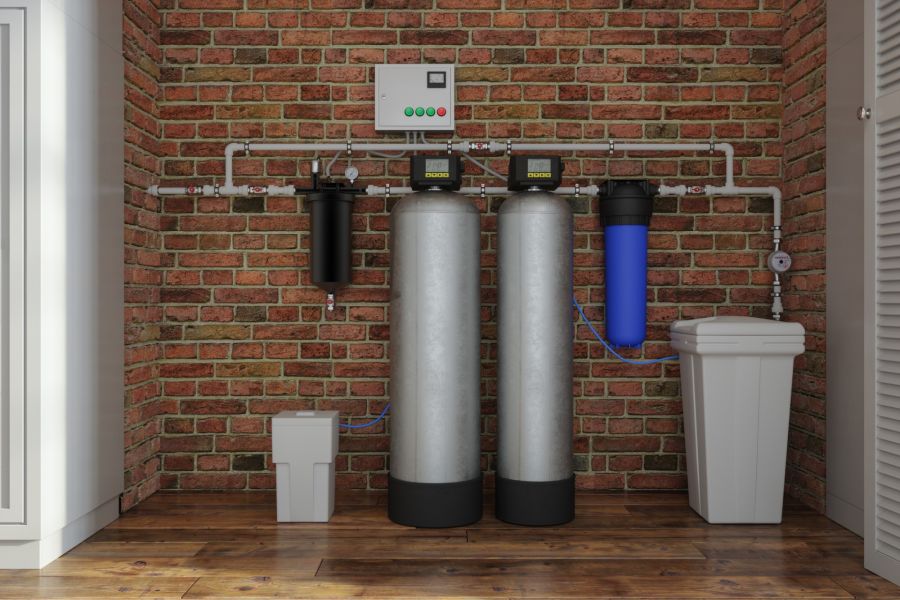
For households wanting comprehensive treatment. A combo system in Peoria pairs a water softener with a whole house carbon filter, addressing both scale and chloramine at every tap while a reverse osmosis system under the kitchen sink handles drinking water. This combination represents whole-home water quality management and is the most common recommendation for Peoria homes with older plumbing or water-intensive appliances.
How to read Peoria's Consumer Confidence Report
The City of Peoria must publish a Consumer Confidence Report (CCR) by July 1 each year under the Safe Drinking Water Act (40 CFR Part 141, Subpart O). The report lists every regulated contaminant tested in the prior calendar year, the level detected, the EPA MCL, and whether Peoria water met that standard.
The Peoria CCR is available at peoriaaz.gov/residents/utilities/water-services. Independent access to reported data from all Arizona public water systems is also available through the Arizona Department of Environmental Quality at azdeq.gov/water and the EPA SDWIS database at enviro.epa.gov.
Key parameters to find in the Peoria CCR:
- Hardness: reported in mg/L as calcium carbonate; divide by 17.1 to convert to grains per gallon
- TDS: listed as a secondary standard; look for seasonal range rather than a single annual number
- Disinfectant residual: Peoria reports chloramine as the disinfectant; look for the running range and annual average
- Total trihalomethanes (TTHMs): annual average vs. the 80 ppb MCL
- Haloacetic acids (HAA5): annual average vs. the 60 ppb MCL
- Arsenic: reported as micrograms per liter vs. the 10 ppb MCL
- Nitrate: MCL is 10 mg/L as nitrogen; urban Peoria typically reports well below this
- PFAS: beginning with the 2024 reporting cycle, six PFAS compounds will appear in CCRs for large systems
CCR data represents water quality at the treatment plant or within the distribution system as a whole. It does not reflect the specific conditions at your tap, which depend on your service line material, your internal plumbing age, and your pressure zone. A home water test measures what arrives at your fixtures.
Compare Peoria's profile with neighboring northwest Valley cities: see our guides for Phoenix water quality and Scottsdale water quality. For the east Valley, see Tempe water quality, Gilbert water quality, and Mesa water quality.
Water quality dataset: Peoria AZ compiled from public sources
The following table compiles publicly available water quality parameters for the City of Peoria from the City of Peoria Consumer Confidence Report and the EPA SDWIS database. Parameter values reflect ranges reported in recent years; refer to the current CCR at peoriaaz.gov for the most recent annual data.
| Parameter | Typical range | Unit | EPA MCL | Source |
|---|
| Hardness | 200 to 350 | mg/L as CaCO3 | None (aesthetic) | City of Peoria CCR; peoriaaz.gov |
| Total dissolved solids | 500 to 750 | mg/L | 500 (secondary) | City of Peoria CCR |
| Total trihalomethanes (TTHMs) | below MCL | ppb | 80 | City of Peoria CCR; 40 CFR 141 |
| Haloacetic acids (HAA5) | below MCL | ppb | 60 | City of Peoria CCR; 40 CFR 141 |
| Arsenic | below MCL | ppb | 10 | City of Peoria CCR; ADEQ |
| Nitrate | below MCL | mg/L as N | 10 | City of Peoria CCR |
| Fluoride (added) | approx 0.7 | mg/L | 4.0 | City of Peoria CCR; EPA optimal |
| Chloramine residual | 0.5 or above | mg/L | 4.0 (MRDL) | City of Peoria CCR; 40 CFR 141 |
| PFAS (monitoring 2024+) | reporting in progress | ppt | 4 (PFOA/PFOS) | EPA PFAS Rule, April 2024 |
Method: Parameters compiled from the City of Peoria Water Services Consumer Confidence Reports and the EPA Safe Drinking Water Information System (SDWIS) at enviro.epa.gov. Ranges represent recent multi-year data; consult the current CCR at peoriaaz.gov for the most recent annual values. This table does not substitute for a home water test, which measures conditions at your specific tap.
Free water test in Peoria AZ: what to expect
A professional free water test in Peoria AZ measures your water at the tap, not at the treatment plant. The test covers:
- Hardness in grains per gallon at your specific address
- Total dissolved solids in mg/L
- Chloramine residual
- Iron and manganese at your tap
- pH
Tap-level testing captures what your service line and internal plumbing contribute to water quality beyond what leaves the treatment facility. A home built before 1986 may have copper plumbing with lead-containing solder joints; a home with galvanized steel pipe may show elevated iron. These conditions are invisible in the district-level CCR data.
After testing, a Purest Water Solutions specialist walks through the numbers with you and recommends only the treatment options that address what your water actually shows. If your hardness is at the low end of the Peoria range, a different softener size is appropriate than for an address at the high end. If your iron is negligible, there is no reason to include an iron filter. Treatment recommendations are grounded in measured results, not default packages.
Schedule your free water test in Peoria AZ or call (949) 873-1129. We serve Peoria and nearby Glendale. For commercial accounts in the northwest Valley, see our commercial reverse osmosis options for Phoenix metro.
Purest Water Solutions serves Peoria, Phoenix, Scottsdale, Tempe, Gilbert, Mesa, Chandler, and the greater Phoenix metro area. We also serve Rancho Cucamonga, the Inland Empire, Orange County, Los Angeles County, and San Bernardino County. View all service areas or call (949) 873-1129.