Huntington Beach tap water is safe to drink. The city's water meets all EPA primary drinking water standards and California State Water Resources Control Board requirements. However, Huntington Beach water is hard, typically testing 200 to 340 mg/L as calcium carbonate depending on the seasonal blend of local groundwater and imported water. That converts to roughly 12 to 20 grains per gallon, a range the Water Quality Association classifies as hard to very hard. The city draws from two primary sources: the Orange County groundwater basin managed by OCWD, which runs harder, and imported surface water from Metropolitan Water District, which runs softer. PFAS monitoring is active in the OC basin and OCWD has put treatment in place at affected wells. This guide compiles the publicly available water quality data for Huntington Beach and explains what it means for homeowners considering a whole house water filtration system.
Where does Huntington Beach get its water?
Huntington Beach water comes from two sources that are blended in varying proportions throughout the year. The primary source is groundwater from the Orange County groundwater basin, a 750-square-mile aquifer system managed by the Orange County Water District (OCWD). The secondary source is imported surface water purchased from the Metropolitan Water District of Southern California (MWD), which delivers water from the Colorado River and the State Water Project.
OCWD manages the largest groundwater basin in Southern California. The district replenishes the basin using a combination of local storm water capture and the Groundwater Replenishment System (GWRS), which processes highly treated recycled water and injects it into the basin. GWRS is the world's largest water purification system of its type, capable of producing up to 130 million gallons of purified water per day for basin replenishment, according to OCWD's program page.
The ratio of groundwater to imported water shifts with rainfall and availability. During wet years, local groundwater supplies more of the total. During dry years, MWD imports fill a larger share. This seasonal variation is one reason hardness at the tap in Huntington Beach fluctuates throughout the year.
MWD itself blends water from two conveyance systems: the Colorado River Aqueduct and the State Water Project. Colorado River water is considerably harder (typically 300 to 400 mg/L TDS) while State Water Project water from Northern California is softer (typically 200 to 300 mg/L TDS). The blend that arrives in Southern California varies based on statewide water availability and MWD's storage strategy. MWD publishes this data in its annual water quality reports.
Is Huntington Beach tap water safe to drink?
Yes. Huntington Beach water consistently meets all EPA primary drinking water standards and California's more stringent requirements under the State Water Resources Control Board Division of Drinking Water.
The City of Huntington Beach Public Works department distributes water through roughly 680 miles of pipeline to residential and commercial customers. The city publishes an annual Consumer Confidence Report (CCR) that covers testing results for every regulated contaminant. You can access the report from the City of Huntington Beach website under the Public Works or Utilities section.
OCWD also publishes an annual water quality report covering the groundwater basin as a whole, with detailed contaminant data at the district level. That report is available from the OCWD water quality page.
Safe to drink and pleasant to drink are not the same thing. At 12 to 20 gpg hardness, Huntington Beach water produces visible scale on shower doors and faucet aerators within weeks. Soap takes longer to lather and rinse. Glasses come out of the dishwasher cloudy. Water heaters accumulate scale on heat exchange surfaces, reducing efficiency and shortening equipment life. These are quality-of-life issues, not safety concerns, but they are real and measurable.
Huntington Beach water hardness: what the data shows
Hardness measures the concentration of dissolved calcium and magnesium in water. It is expressed either in milligrams per liter as calcium carbonate (mg/L as CaCO3) or in grains per gallon (gpg). One gpg equals 17.1 mg/L.
Orange County basin groundwater has historically tested on the harder end due to the mineralogy of the aquifer. As water moves through the basin, it dissolves calcium carbonate and magnesium from the surrounding rock and sediment. The result is groundwater that typically tests between 16 and 22 gpg, depending on which portion of the basin and which specific wells are in production.
Imported MWD water is softer. Colorado River water supplied via the Colorado River Aqueduct typically arrives at 300 to 400 mg/L TDS with hardness around 17 to 23 gpg. State Water Project water is softer at 200 to 300 mg/L TDS and roughly 12 to 17 gpg hardness. When MWD blends the two and delivers the result south, the final hardness depends on the seasonal mix.
The following table summarizes hardness ranges by source, compiled from OCWD, MWD, and EPA published data:
| Water Source | Hardness (mg/L as CaCO3) | Hardness (gpg) | Primary Sources |
|---|
| OC Groundwater Basin (typical) | 270 to 380 | 16 to 22 | OCWD Annual Water Quality Report |
| MWD Colorado River blend | 290 to 400 | 17 to 23 | MWD Water Quality Report |
| MWD State Water Project blend | 200 to 290 | 12 to 17 | MWD Water Quality Report |
| Huntington Beach tap (blended, typical) | 200 to 340 | 12 to 20 | City of HB CCR (varies by season) |
| EPA threshold for "hard" water | above 120 | above 7 | EPA drinking water guidance |
The Water Quality Association defines water hardness categories as follows: 0 to 60 mg/L (0 to 3.5 gpg) is soft; 61 to 120 mg/L (3.5 to 7 gpg) is moderately hard; 121 to 180 mg/L (7 to 10.5 gpg) is hard; above 180 mg/L (above 10.5 gpg) is very hard. Huntington Beach consistently falls in the very hard category across all source blends. You can review the WQA's hardness classification at the Water Quality Association website.
At the high end of the range, 20 gpg hardness is roughly equivalent to having half a teaspoon of dissolved calcium and magnesium per gallon of water. That sounds minor, but over time it accumulates as scale inside pipes, water heaters, and appliances. A water heater operating in water at 17 to 20 gpg can accumulate enough scale to reduce efficiency by 20 to 30 percent within three to five years if untreated, according to research published by the U.S. Department of Energy. The impact on water heaters in Huntington Beach is one of the most common reasons homeowners in this city contact us for a treatment recommendation.
The Orange County water quality data guide covers how Huntington Beach compares to other OC cities and explains how the basin's geology produces these hardness levels. The Orange County water softener guide also breaks down hardness by city and what each range means for appliance purchases.
PFAS contamination in Orange County groundwater
Per- and polyfluoroalkyl substances (PFAS) are a class of synthetic chemicals used in industrial and consumer products since the 1950s. They are persistent in the environment and have been detected in groundwater supplies across the United States. The EPA finalized maximum contaminant levels (MCLs) for six PFAS compounds in April 2024, setting limits for PFOA and PFOS at 4 parts per trillion (ppt). This is the most protective federal drinking water standard ever issued for PFAS.
OCWD began monitoring PFAS in the Orange County groundwater basin as part of a regional assessment that followed the EPA's 2016 health advisories. The district found PFAS compounds in wells distributed across the basin, with the highest concentrations near former industrial sites and locations where PFAS-containing firefighting foam was historically used.
OCWD's response has been active. The district has put granular activated carbon (GAC) treatment systems in place at wells where PFAS detections exceeded California's action levels. GAC treatment physically adsorbs PFAS molecules onto carbon media, removing them from the water stream before distribution. OCWD publishes PFAS testing data and treatment updates on its PFAS program page.
Water distributed to Huntington Beach customers from treated sources complies with both California action levels and the EPA's new April 2024 MCLs. If you want to review the most recent PFAS test results specifically for the wells serving your Huntington Beach address, the city's annual CCR lists the utility's aggregate results and any detections above reporting thresholds.
For homeowners who want to address trace PFAS at the point of use regardless of utility compliance, the most effective in-home options are activated carbon block filters or reverse osmosis systems. NSF International has certified specific products under NSF/ANSI Standard 58 (for reverse osmosis) and NSF/ANSI Standard 53 (for activated carbon) for PFAS reduction. The NSF certification database lets you search by contaminant and product type. You can also review PFAS treatment data in the context of the broader region in the Inland Empire PFAS water data guide and the Los Angeles County PFAS water data guide.
What this means for whole house water filtration in Huntington Beach
The water quality data for Huntington Beach points to two main treatment priorities:
Hardness at 12 to 20 gpg. At this level, scale accumulation is rapid and measurable. A water heater that runs at 18 gpg will develop scale on the heat exchange surface within months. Dishwashers, washing machines, and coffee makers all have shorter service lives in very hard water. For whole house hardness control, a salt-based ion exchange water softener removes calcium and magnesium ions from water before it reaches your fixtures and appliances. Ion exchange is the only method that actually removes hardness minerals; TAC conditioners change mineral behavior but do not reduce hardness levels on a test strip.
Chloramine disinfection. Like most Southern California utilities, the city uses chloramine (rather than free chlorine) as its primary residual disinfectant. Chloramine is more stable over long distribution distances, which makes it practical for a system the size of Huntington Beach's. However, chloramine requires specific filter media to remove it effectively. Standard activated carbon does not remove chloramine. You need catalytic carbon or a chloramine-specific blend to reduce it from drinking and bathing water. A whole house carbon filter with catalytic carbon addresses this at the point of entry.
PFAS at trace levels. For most Huntington Beach customers, PFAS levels in delivered water comply with EPA and California standards following OCWD's treatment program. Homeowners who want additional reduction at the kitchen sink can add a certified reverse osmosis or activated carbon point-of-use system. This is not a whole house treatment priority unless testing at your specific tap shows elevated levels, which a free water test in Huntington Beach can verify.
Water treatment options for Huntington Beach homes
The profile of Huntington Beach water (hard, chloraminated, trace PFAS from groundwater sources) fits a layered treatment approach that addresses each issue at the right stage.
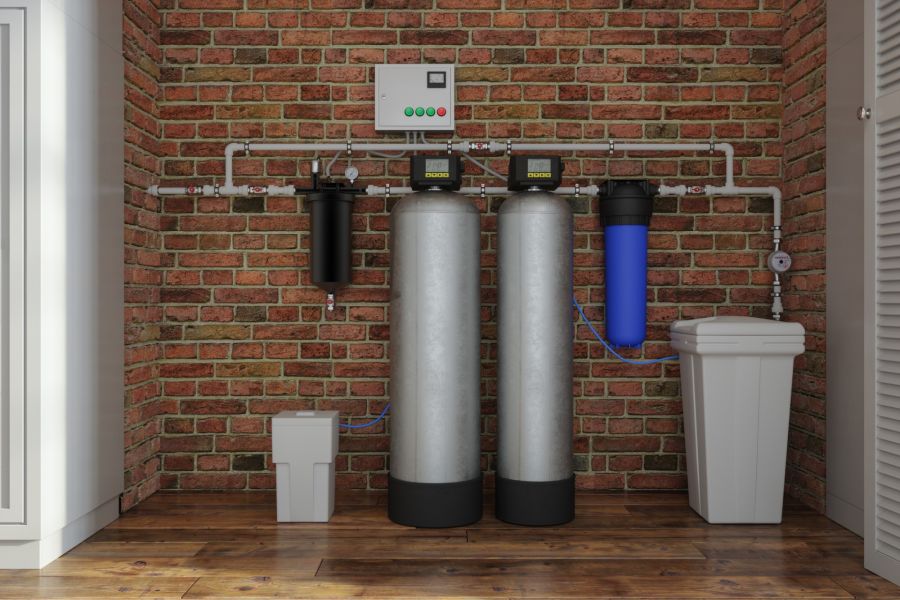
Salt-based ion exchange water softener. This is the most effective whole house hardness solution at 12 to 20 gpg. A resin tank filled with sodium-charged beads captures calcium and magnesium ions and releases sodium in exchange. The resin regenerates periodically using a brine solution. Modern demand-initiated softeners regenerate based on measured water use rather than a fixed timer, using salt only when needed. At Huntington Beach hardness levels, a properly sized softener dramatically reduces scale on fixtures and appliances, improves soap lather, and extends the life of water heaters and washing machines.
Unlike some inland Orange County communities, Huntington Beach does not have a blanket prohibition on salt-based softeners. You should check with your homeowner's association or local ordinance if you are in a specific community, but there is no district-wide ban comparable to Irvine Ranch Water District's restriction. For a detailed look at softener options, see water softeners in Huntington Beach and the best water softeners for homes guide. The whole house water filtration guide for Huntington Beach covers sizing specifics.
Whole house catalytic carbon filter. Positioned upstream of the softener, a whole house carbon filter with catalytic carbon media removes chloramine, chlorine, herbicides, pesticides, and organic compounds before they reach every faucet and shower in the house. Standard carbon will not remove chloramine effectively; the catalytic version creates a chemical reaction that breaks the chloramine bond. A good whole house carbon filter also reduces the load on the softener resin and extends the life of both systems.
Point-of-use reverse osmosis for drinking water. An under-sink RO system at the kitchen tap gives you a final purification stage for drinking and cooking water. See reverse osmosis systems in Huntington Beach for system options for this service area. RO membranes remove a wide range of contaminants including dissolved solids, PFAS, nitrates, arsenic, and most everything else at the ionic or molecular level. The result is water that tastes clean and flat, close to distilled in quality. An RO system connects to a dedicated tap at the sink and a refrigerator line if needed. Most Huntington Beach homeowners who combine a softener with a whole house carbon filter still choose an under-sink RO for drinking water, because the softener replaces calcium and magnesium with sodium, which some people prefer to remove for drinking.
Combination systems. Some homeowners prefer a single integrated solution rather than separate components. Combo systems in Huntington Beach combine softening and filtration in one unit. For general guidance on whole-house options, the best whole house water filtration for homes guide compares the main system types.
Testing before choosing. Water quality at your specific Huntington Beach address depends on which wells and source blend are active in your distribution zone. A free water test in Huntington Beach gives you measured hardness, TDS, pH, and chloramine at your tap. That data determines the right equipment size and configuration rather than relying on district-wide averages that may not match your exact supply.
Ready for a system tailored to your Huntington Beach water? Our trained technicians visit your home, test hardness, TDS, chlorine, and pH at your tap, and give you recommendations based on your results before any equipment is discussed. Schedule your free water test or call (949) 873-1129.
Key sources and data
The data in this guide is compiled from the following publicly available sources: