Rancho Cucamonga tap water comes from Cucamonga Valley Water District (CVWD). CVWD serves more than 200,000 residents in Rancho Cucamonga, Ontario, and Fontana. Its 2024 Consumer Confidence Report covers results from over 40,000 water samples tested against more than 260 contaminants. Water hardness across the CVWD service area ranges from 81 to 190 milligrams per liter, roughly 5 to 11 grains per gallon. That range spans moderately hard to hard, depending on the source blend at your location. CVWD does not add fluoride; it occurs naturally at an average of 0.33 parts per million. Disinfection byproducts, hexavalent chromium, arsenic, and the legacy pesticide DBCP appear in CVWD's system, all below federal Maximum Contaminant Levels. Some results exceed California's more protective voluntary health guidelines. Every result in 2024 met state and federal compliance standards.
Schedule a free water test in Rancho Cucamonga to see exactly what is in your tap water. Call us at (949) 873-1129.
Where does Rancho Cucamonga's drinking water come from?
Rancho Cucamonga sits at the base of the San Gabriel Mountains in western San Bernardino County, within a service territory that also spans portions of Ontario and Fontana. Two water sources supply the CVWD system, and their blend ratio shifts throughout the year.
The first source is imported surface water from the Metropolitan Water District of Southern California (MWD). MWD delivers Colorado River water via the Colorado River Aqueduct and Northern California water through the State Water Project. Both are treated at MWD's Robert B. Diemer Filtration Plant in Yorba Linda before reaching CVWD. Colorado River water carries dissolved calcium, magnesium, and sodium picked up crossing the arid Southwest. MWD reports a total hardness averaging around 228 milligrams per liter at its treatment plant outlets (mwdh2o.com), which is classified as hard.
The second source is groundwater from the Chino Basin, a major alluvial aquifer in San Bernardino and Riverside Counties. The basin has a long history of agricultural use. That history is why legacy chemicals like DBCP (1,2-Dibromo-3-chloropropane) appear in parts of the groundwater supply. DBCP was banned in the U.S. in 1979 but persists in aquifer sediments decades later.
CVWD blends these two sources throughout its system. The mix varies by season, by zone, and by drought conditions. Dry years push utilities to draw more groundwater. That shift raises hardness and can change the contaminant profile. Two neighbors in Rancho Cucamonga can see different tap water readings within the same utility district for this reason.
For context on how groundwater geology shapes water quality across this region, see our overview of water hardness by city across the Inland Empire.
What does the Cucamonga Valley Water District Consumer Confidence Report show?
California law requires every public water system serving 25 or more people to publish an annual Consumer Confidence Report (CCR) by July 1. The CCR covers water quality data for the prior calendar year. CVWD files this report with the California State Water Resources Control Board's Electronic Annual Reporting database (waterboards.ca.gov) and posts it publicly on its website at cvwdwater.com.
CVWD's 2024 Consumer Confidence Report covers more than 40,000 water samples tested for over 260 contaminants. Only detected contaminants appear in the report's data tables. That is standard practice under the federal Safe Drinking Water Act.
The table below summarizes key water quality parameters for the CVWD service area based on data from CVWD's published reports and FAQs.
| Parameter | Result | Standard or Benchmark |
|---|
| Water hardness | 81-190 mg/L (approx. 5-11 grains per gallon) | WQA "hard" above 120 mg/L (7 gpg) |
| Fluoride (naturally occurring) | 0.33 ppm average | EPA MCL: 4.0 ppm; Secondary: 2.0 ppm |
| Total trihalomethanes (TTHMs) | Detected; below MCL | EPA MCL: 80 micrograms per liter |
| Haloacetic acids (HAA5) | Detected; below MCL | EPA MCL: 60 micrograms per liter |
| Hexavalent chromium (Cr-6) | Detected | California MCL: 10 micrograms per liter (set 2023) |
| Arsenic | Detected; below MCL | EPA MCL: 10 parts per billion |
| DBCP (legacy pesticide) | Detected in portions of system | EPA MCL: 0.0002 mg/L |
Sources: CVWD Water Quality FAQ (cvwdwater.com/faq.aspx?TID=22); CVWD Fluoride FAQ (cvwdwater.com/faq.aspx?TID=25); CVWD 2024 Water Quality Report (cvwdwater.com). All contaminants in CVWD's 2024 report fell below federal MCLs.
What is the water hardness in Rancho Cucamonga?
Water hardness is the concentration of dissolved calcium and magnesium in the water supply. When water heats or evaporates, these minerals precipitate out of solution and form the white crusty deposits visible on showerheads, faucet aerators, and glass shower doors. Inside water heaters, the same scale insulates the heating element from the water, forcing the unit to consume more energy to reach temperature.
CVWD's published FAQ states that water hardness across its service area ranges from 81 to 190 milligrams per liter (cvwdwater.com). That is equivalent to roughly 5 to 11 grains per gallon. The Water Quality Association classifies water above 120 mg/L (7 gpg) as hard and water above 180 mg/L (10.5 gpg) as very hard. CVWD's range spans both categories. Some zones receive water the WQA classifies as moderately hard, while others cross into the hard or very hard range.
The variation comes from the blend ratio. MWD surface water zones and local groundwater zones carry different hardness profiles because the two sources have different mineral compositions. Groundwater zones draw more heavily from the Chino Basin and typically test at the higher end of the hardness range.
At hardness levels above 120 mg/L (7 gpg), you will see scale building on fixtures, inside the dishwasher, and around the heating element of the water heater. At the top of CVWD's range, near 190 mg/L (11 gpg), the scale rate accelerates and appliance manufacturers' warranties can be affected by inadequate water softening. Our guide to hard water signs covers the specific indicators Rancho Cucamonga homeowners report most often.
For households with hardness readings above 7 gpg, water softeners using ion exchange are the standard solution. An ion exchange softener replaces calcium and magnesium ions with sodium ions as water enters the home, which eliminates scale throughout every fixture, pipe, and appliance downstream. Purest Water Solutions provides water softeners throughout San Bernardino County and the Inland Empire.
A free in-home water test in Rancho Cucamonga measures hardness at your specific tap rather than using a district average. Two homes a block apart can see different readings based on which groundwater zones feed their pressure district.
What contaminants are detected in Rancho Cucamonga water?
CVWD's 2024 Consumer Confidence Report identified contaminants that fall into three categories: disinfection byproducts, naturally occurring minerals, and legacy industrial or agricultural chemicals. All results fell below federal Maximum Contaminant Levels (MCLs), meaning the water met legal compliance standards in 2024. Some contaminants were detected above California's voluntary health-based advisory guidelines, which are more stringent than the enforceable federal and state limits.
Disinfection byproducts: CVWD uses chlorine to disinfect its supply. Chlorine reacts with organic matter in source water to form disinfection byproducts. These include total trihalomethanes (TTHMs) and haloacetic acids (HAA5s). TTHMs cover four compounds: chloroform, bromodichloromethane, bromoform, and dibromochloromethane. They appear in nearly every chlorinated water system in the U.S. The EPA's MCL is 80 micrograms per liter for TTHMs and 60 for HAA5s. CVWD's 2024 results stayed below both limits.
Hexavalent chromium (chromium-6): Chromium-6 is a naturally occurring and industrial contaminant found throughout Southern California's groundwater and in surface water supplies. California set the nation's first chromium-6 Maximum Contaminant Level in 2023, at 10 micrograms per liter. This standard applies statewide, including to CVWD. CVWD's 2024 report detected chromium-6 at levels below this MCL. California's public health goal is a voluntary, aspirational target rather than an enforceable limit. It sits far below the MCL, which is why chromium-6 often appears in the "exceeds health-based guidelines" column even in legally compliant systems. For a deeper look at chromium-6 and PFAS across the region, see our report on PFAS in Inland Empire water data.
Arsenic: Arsenic is a naturally occurring element in groundwater throughout Southern California, particularly in areas with volcanic and sedimentary geology. The federal MCL for arsenic is 10 parts per billion. CVWD's 2024 CCR detected arsenic at levels below this limit. California's public health goal for arsenic is 0.004 parts per billion, far below the federal MCL. This gap explains why arsenic appears in the "contaminants exceeding health-based guidelines" count even in compliant systems.
DBCP (1,2-Dibromo-3-chloropropane): DBCP is a soil fumigant and nematicide that was used extensively in California agriculture before its ban in 1979. It remains detectable in portions of the Chino Basin groundwater because of its persistence in aquifer sediments. The EPA's MCL for DBCP is 0.0002 milligrams per liter. CVWD monitors for DBCP and detected it in portions of its distribution system. These detections have prompted ongoing remediation and groundwater management efforts coordinated through the Chino Basin Watermaster.
PFAS: According to available public data for CVWD, no PFAS compounds in the CVWD system are currently above EPA health-based advisory guidelines. For the full analysis of PFAS contamination in the Chino Basin specifically, see our dedicated article on Rancho Cucamonga PFAS water contamination and the Chino Basin.
Two terms matter when reading CVWD's report. An MCL (Maximum Contaminant Level) is the highest amount of a contaminant legally allowed in drinking water. A public health goal (PHG) is a non-enforceable target set at the level scientists consider safest over a lifetime of exposure. California PHGs are often far lower than MCLs. They reflect protective science without the cost constraints that shape enforceable limits. A contaminant can be at a legal MCL and still exceed the PHG. A water test at your tap helps you decide whether treatment makes sense.
How does Rancho Cucamonga water compare to the rest of the Inland Empire?
The Inland Empire shares a common water challenge: hard water from blended Colorado River imports and local groundwater that has percolated through calcium-rich geology. Rancho Cucamonga's CVWD service area falls in the mid-range of the region's hardness spectrum.
San Bernardino County utilities to the east and south share similar contaminant profiles. TTHMs from chlorine disinfection, chromium-6, and arsenic are common findings across the region. Our analysis of San Bernardino County water quality covers the county-wide picture. Riverside County utilities show comparable challenges with some additional variation. Lake Elsinore, for example, has very high TDS readings around 1,010 parts per million, which puts Rancho Cucamonga's moderate TDS range in context. See our report on Riverside County water quality data for that comparison.
Rancho Cucamonga's proximity to the Chino Basin is its most distinctive characteristic relative to other IE communities. The Chino Basin has a long history of intensive agriculture and industrial activity. This left a legacy contamination profile in the groundwater that does not appear to the same degree in communities drawing from MWD surface water or from basins with less agricultural history. This is the reason DBCP appears in CVWD's reports and why iron filter considerations for San Bernardino County are relevant to neighborhoods near heavier groundwater draw zones.
What water treatment systems address Rancho Cucamonga water quality issues?
The water quality profile in Rancho Cucamonga presents two distinct problems that require two different treatment approaches: whole-house hardness and drinking water contaminants.
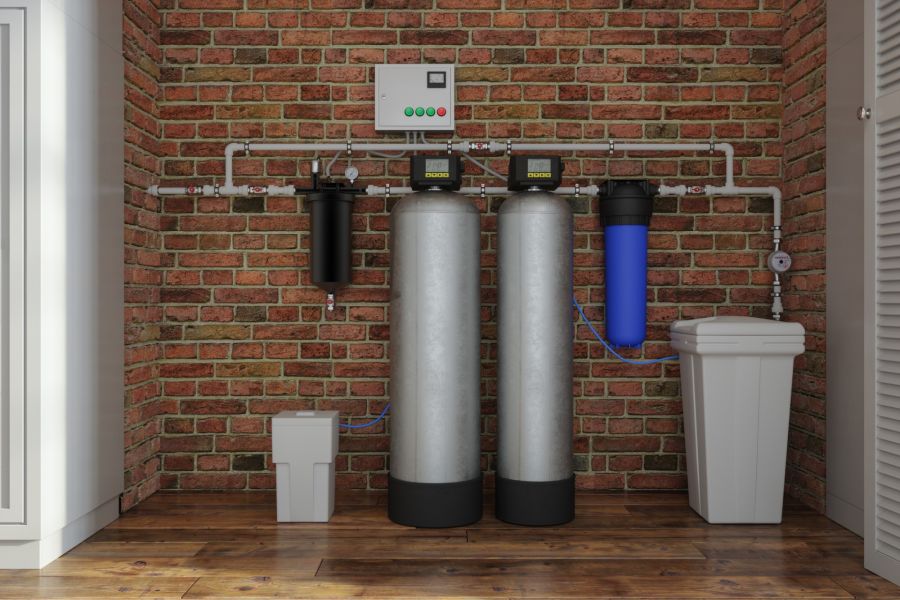
For hardness (scale, appliance wear, dry skin and hair): A water softener using ion exchange is the standard whole-house solution. The softener sits at the point of entry to the home, upstream of every fixture and appliance. As water passes through the resin tank, sodium ions displace calcium and magnesium ions, eliminating the source of scale throughout the entire plumbing system. At CVWD's hardness range of 81 to 190 mg/L, a properly sized softener eliminates scale on water heaters, dishwashers, washing machines, faucets, and showerheads. Water heater efficiency, dishwasher performance, and the lifespan of plumbing fixtures all improve measurably when scale accumulation stops.
For drinking water contaminants (TTHMs, chromium-6, arsenic, DBCP): A reverse osmosis system at the kitchen tap or refrigerator line is the most effective point-of-use solution for dissolved contaminants. Reverse osmosis systems certified to NSF/ANSI Standard 58 reduce total trihalomethanes, hexavalent chromium, arsenic, nitrates, and a wide range of other dissolved contaminants by 90 to 99 percent at the drinking tap. This targeted approach addresses the contaminants that matter most for drinking and cooking without requiring whole-house treatment for every gallon used outdoors or in plumbing.
For comprehensive protection: A whole house filtration system combined with a point-of-use reverse osmosis unit addresses both problems in one system. The whole-house system handles sediment, chlorine taste and odor, and certain organics throughout every tap in the home. The reverse osmosis unit handles dissolved contaminants at the drinking tap. Purest Water Solutions pairs these systems for homeowners across San Bernardino County.
For iron and manganese: Some groundwater-dominant zones in the Chino Basin service area carry elevated iron, which shows as rust-colored staining on fixtures and laundry. An iron filter addresses this before water reaches the softener, protecting the resin and extending softener life.
The right combination depends on what is actually present at your tap. CVWD's district-wide CCR gives you the range of what can be present. A free in-home water test gives you the specific reading at your address. Our technicians work throughout Rancho Cucamonga and all of San Bernardino County.
How to find CVWD's Consumer Confidence Report
Every Rancho Cucamonga resident served by CVWD can access the full Consumer Confidence Report through two channels.
The first is CVWD's website. The district posts its annual Water Quality Report in the Water Quality section at cvwdwater.com. Past reports are archived there as well, allowing year-over-year comparison.
The second channel is the California State Water Resources Control Board's Electronic Annual Reporting database at waterboards.ca.gov. Search by "Cucamonga Valley Water District" to locate CVWD's filed reports. The EPA also maintains a national CCR lookup tool at epa.gov/ccr.
Your CCR lists every contaminant tested, the detected level, the federal MCL, whether the result was in compliance, and the water source. Reading it alongside a professional water test at your tap gives you the most complete picture of what is in your Rancho Cucamonga drinking water.
For questions about what a specific CCR result means for your home, or to schedule a free water test, call Purest Water Solutions at (949) 873-1129. We specialize in the specific water quality challenges in Rancho Cucamonga, the Chino Basin service area, and San Bernardino County as a whole. We serve all of Rancho Cucamonga and the surrounding Inland Empire.
Frequently asked questions about Rancho Cucamonga water quality
Is Rancho Cucamonga tap water safe to drink?
CVWD met all state and federal drinking water standards in 2024. All contaminants in the 2024 Consumer Confidence Report fell below Maximum Contaminant Levels set by the EPA and California's Division of Drinking Water. However, some detected contaminants exceed California's more protective voluntary health-based advisory guidelines. Compliance is the legal standard; it does not mean every detected contaminant is below the level scientists consider ideal for long-term health. A free water test in Rancho Cucamonga identifies which contaminants are present at your specific tap.
How hard is the water in Rancho Cucamonga?
CVWD reports water hardness ranging from 81 to 190 milligrams per liter, about 5 to 11 grains per gallon (cvwdwater.com). This range is classified as moderately hard to hard by the Water Quality Association. Your specific reading depends on the source blend in your pressure zone. Water softeners address hardness at every tap and appliance in the home.
Does Rancho Cucamonga add fluoride to the water?
No. CVWD does not add fluoride to its supply. Fluoride is naturally present at an average of 0.33 parts per million in some CVWD source water, well below the federal Maximum Contaminant Level of 4.0 ppm (cvwdwater.com).
What contaminants are in Rancho Cucamonga water?
CVWD's 2024 CCR detected trihalomethanes, haloacetic acids, hexavalent chromium, arsenic, and DBCP in portions of the distribution system, all below federal MCLs. Reverse osmosis systems certified to NSF/ANSI Standard 58 reduce all of these contaminants by 90 to 99 percent at the drinking tap.
How does Rancho Cucamonga water compare to neighboring cities?
Hardness in the 81 to 190 mg/L range is consistent with other Inland Empire communities served by similar MWD and Chino Basin blends. Our city-by-city Inland Empire water hardness guide and San Bernardino County water quality report provide detailed comparisons across the region.