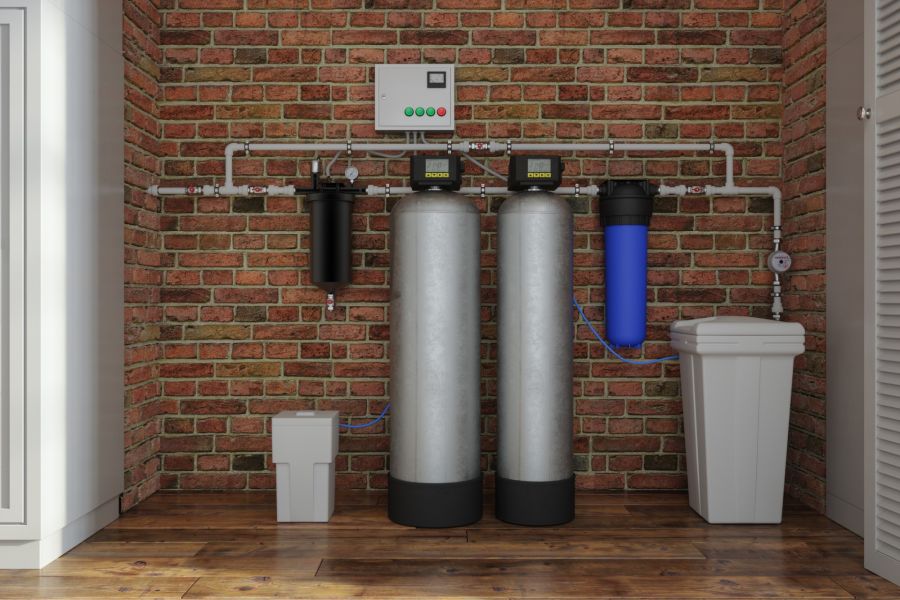
Iron in San Bernardino County tap water and well water is a documented problem tied to the region's geology. The county draws from multiple groundwater basins where alluvial sediments and deep aquifer zones with low oxygen allow iron to dissolve into the water supply. The EPA secondary maximum contaminant level for iron is 0.3 mg/L, a threshold the agency established because water above that concentration stains plumbing, fixtures, laundry, and appliances with rust-colored deposits (source: EPA Secondary Drinking Water Standards). California adopted the same 0.3 mg/L threshold as an enforceable secondary MCL under Title 22 of the California Code of Regulations. This guide covers how to identify whether your San Bernardino County home needs an iron filter, what filter types match different iron concentrations and forms, and how to maintain the system once it is running.
Schedule a free water test in San Bernardino County before selecting a system. Call (949) 873-1129.
What Iron Levels Are Too High in Drinking Water?
The practical threshold for iron in drinking water is 0.3 mg/L. The EPA established this as its secondary maximum contaminant level under 40 CFR Part 143, which governs aesthetic and nuisance parameters. Secondary MCLs are not federally enforceable but represent the concentration above which most users experience noticeable taste, odor, or staining problems. California made the iron threshold enforceable for public water systems through Title 22 of the California Code of Regulations.
At 0.3 mg/L, water leaves orange or brown staining on toilets, sinks, tubs, and laundry. Lower concentrations, from 0.1 to 0.2 mg/L, can produce a detectable metallic taste in some users. Higher concentrations, above 1 mg/L, produce visible rust tint in the water itself and heavy staining on everything the water contacts.
Iron is not a federally regulated primary contaminant at concentrations typical in drinking water, which means there are no federal enforceable health-based limits equivalent to what exists for lead or arsenic. The secondary MCL threshold is therefore the primary benchmark for determining when iron removal equipment is warranted.
For San Bernardino County homeowners on private wells, no utility treatment system stands between the aquifer and the tap. Groundwater iron in the county's major basins varies significantly by location, depth, and the specific aquifer zone the well draws from. A certified lab test measuring iron, manganese, pH, and hardness is the accurate starting point, rather than assuming your well water matches a neighbor's.
Our companion article on iron and manganese in San Bernardino County water covers the basin-by-basin groundwater data in detail, including how the USGS GAMA Inland Empire study unit data maps detected concentrations across the region.
Why Does San Bernardino County Water Contain Iron?
San Bernardino County sits over several major groundwater basins, including the San Bernardino Valley groundwater basin and the Chino Basin. These basins receive recharge from the San Gabriel Mountains through the Santa Ana River and spreading grounds, and they draw from alluvial sediments and older geological formations that contain iron-bearing minerals.
Iron in groundwater is primarily a function of geology and aquifer chemistry. When oxygen is present, iron stays bound to sediment in its insoluble ferric form (Fe3+). When oxygen is depleted, typically in deeper aquifer zones or in zones where organic material consumes dissolved oxygen, conditions become reducing. Under reducing conditions, iron shifts to its soluble ferrous form (Fe2+) and travels with the groundwater to pumping wells. The USGS documents this process in its GAMA Inland Empire study unit report, noting that reducing conditions are present in portions of the monitored wells across the region (USGS Open-File Report 2014-1070, pubs.usgs.gov).
Private wells drilled into affected aquifer zones bring that dissolved iron directly to the tap without treatment. Homes on city water may still see iron issues if the utility blends a significant portion of local groundwater into the distribution system, or if older distribution pipes contribute iron through corrosion.
Understanding whether your iron is ferrous (dissolved, clear water that turns orange on exposure to air) or ferric (already oxidized, appearing as visible rust particles in the tap water) affects which filter technology will work. See the signs you need a whole house water filtration system for the broader picture of when point-of-entry treatment is the right approach.
What Are the Signs You Need an Iron Filter in San Bernardino County?
The clearest indicators of iron above the 0.3 mg/L threshold are visual. Orange or rust-colored staining around toilet bowl waterlines is the most common first sign. Showerheads and tub drains accumulate orange or brown scale. White laundry develops a faint rust tint over multiple wash cycles. Dishwasher interiors and white porcelain develop staining that cleaning products do not remove.
A metallic or earthy taste in unfiltered tap water is another indicator, particularly with ferrous iron that dissolves without producing visible color at the tap. Some residents notice the smell before the taste, often described as a rusty or iron-like odor from hot water in particular, because heat accelerates iron oxidation inside the water heater and pipes.
Inside the home, water heaters operating on high-iron supply accumulate iron sludge in the tank over time. Flushing the drain valve on an affected water heater often releases brown or orange water, indicating iron deposits. This sludge reduces heating efficiency and shortens tank life.
Outside the home, orange streaking on concrete driveways, patios, or garage floors from irrigation systems using well water indicates iron above 0.3 mg/L in the outdoor supply. Lawn sprinklers leave rust-orange marks where water contacts concrete.
If you are seeing any of these signs, a water test will confirm iron levels at your tap, which may differ from the utility average in a CCR due to local pipe conditions or supply blend ratios. See the free water testing guide to understand what a field test measures and what the results show.
Request a free water test for your San Bernardino County home. Call (949) 873-1129.
What Types of Iron Filters Work for San Bernardino County Water?
Several filter technologies address iron in residential water supply. The right choice depends on iron concentration, iron form (ferrous or ferric), manganese levels, pH, and water hardness.
Oxidizing media filters (greensand and catalytic carbon): These are the most common residential iron removal systems. Greensand is a filter media coated with manganese dioxide that catalyzes the oxidation of dissolved ferrous iron, converting it to insoluble ferric iron that the media then captures. Catalytic carbon media (such as Centaur from Calgon Carbon Corporation) works similarly. Both types regenerate with potassium permanganate or air depending on the system design. Greensand handles iron up to about 10 mg/L and manganese up to about 1 mg/L in typical residential configurations, though specific ratings vary by manufacturer and system design.
Birm media filters: Birm, manufactured by Clack Corporation, is an aluminum silicate filter media coated with manganese dioxide. It catalyzes iron oxidation without chemical regenerant if sufficient dissolved oxygen is present in the water and pH is at or above 6.8. Birm regenerates with a water backwash cycle rather than potassium permanganate, which reduces ongoing maintenance requirements. It is less effective for manganese removal than greensand at equivalent concentrations.
Air injection oxidation systems: These systems inject a pocket of compressed air into the filter tank, creating an air-water contact zone where dissolved iron oxidizes before passing through filter media. No chemical regenerant is required. The system backwashes with water to purge accumulated iron. Air injection systems suit households that prefer to minimize chemical handling. They are effective for ferrous iron and mild manganese concentrations.
KDF-55 media: KDF-55 is a copper-zinc granular media that uses a redox reaction to convert dissolved ferrous iron to ferric iron for filtration. It is often used in combination with other media rather than as a standalone iron filter at high concentrations. KDF media also reduces chlorine, hydrogen sulfide, and some heavy metals.
Combination iron filter and water softener: San Bernardino County water is hard, with hardness levels in most service areas exceeding 200 mg/L as calcium carbonate based on utility CCR data. Many homes dealing with iron staining also deal with scale on fixtures, water heaters, and appliances. A combination system places an iron filter at the point of entry, followed by a softener that handles hardness and any residual low-level iron. See our data on Inland Empire water hardness by city for specific hardness ranges across the region.
The signs you need water softeners guide covers hardness-specific symptoms and when softening alone versus a combination system is the appropriate solution.
Tank size and media volume are selected based on the household's peak flow rate and the iron concentration from the water test. An undersized filter passes water faster than the media can treat, reducing removal efficiency. Sizing is typically calculated against the number of bathrooms, occupants, and peak water demand.
For San Bernardino County homeowners on well water, the county's Division of Environmental Services (SBCDES) maintains records of permitted well locations and construction depths, which can help confirm the aquifer zone your well is drawing from (San Bernardino County Department of Environmental Health, sbcounty.gov).
Do You Need an Iron Filter If You Are on City Water in San Bernardino County?
City water customers in San Bernardino County can still experience iron issues, though the source and severity differ from well water.
Large utilities such as Cucamonga Valley Water District and San Bernardino Municipal Water Department blend local groundwater with imported Metropolitan Water District surface water. The blend ratio varies seasonally. During summer or drought periods when MWD curtailments increase local pumping, a higher proportion of local groundwater may flow through the distribution system. If that groundwater contains iron, the blend proportion directly affects what reaches your tap.
Older distribution pipes, particularly cast iron mains laid before the 1970s, also contribute iron through corrosion. Water chemistry changes during seasonal supply shifts can mobilize iron deposits that have accumulated on pipe walls over decades, producing temporary orange water events at the tap.
If your utility's CCR shows iron detections near or above 0.3 mg/L at the distribution system level, or if you are experiencing staining and the utility is not the source, a point-of-entry iron filter addresses the issue at the home regardless of the supply source.
CCRs for California utilities are searchable at the California Drinking Water Watch database (waterboards.ca.gov). Pull the most recent report for your utility and look for iron under the secondary MCL section to see source and distribution system readings.
Can an Iron Filter Also Remove Manganese?
Yes, in most cases. Manganese co-occurs with iron in San Bernardino County groundwater, particularly in the reducing aquifer zones where both minerals dissolve together. The EPA secondary MCL for manganese is 0.05 mg/L, lower than the iron threshold because manganese affects taste and appearance at lower concentrations. California also set a primary MCL for manganese at 0.5 mg/L in 2024, making it enforceable for public water systems.
Greensand and catalytic carbon media address both iron and manganese in the same filter unit when concentrations are within the media's rated range. Manganese requires a slightly higher oxidation potential than ferrous iron, which is why media selection and pH verification matter more when both are present.
The San Bernardino County iron and manganese water data article covers the regulatory thresholds for manganese in detail, including California's 2024 primary MCL and how the USGS has documented manganese detections in the Inland Empire study area.
When manganese is elevated alongside iron, a water test measuring both parameters and the water's pH and dissolved oxygen level is necessary before selecting media. Some media types require a minimum pH to catalyze manganese oxidation effectively, and San Bernardino County well water pH varies by basin and depth.
How Do You Maintain an Iron Filter?
An iron filter requires periodic maintenance to sustain removal performance.
Backwash monitoring. Most control valves are timer-based and initiate backwash automatically on a set schedule. Confirm the backwash frequency is appropriate for your iron load, and check that the drain line is flowing freely during backwash. If staining returns between backwash cycles, the frequency may need to increase.
Regenerant supply (if applicable). Greensand filters using potassium permanganate require the chemical to be topped up periodically. The control valve manages dosing automatically, but the supply tank needs refilling. Manufacturers specify the correct dose and supply volume for your system size and iron concentration. Never substitute household bleach or other oxidizers for potassium permanganate in a potassium permanganate system.
Annual media inspection. Filter media has a finite service life depending on iron load and water chemistry. Greensand media typically lasts five to ten years in residential applications before requiring replacement, though heavily loaded systems may see shorter service intervals. An annual check of the media bed depth and condition, done during a service visit, catches media degradation before it affects performance.
Post-maintenance water test. After any media replacement or significant system service, a field test at the tap confirms the system is performing as expected. A free water testing appointment can serve as an annual performance check.
For general guidance on maintaining water treatment equipment, our water softener maintenance guide covers control valve maintenance and resin inspection practices that apply broadly across ion exchange and oxidizing filter systems.
Contact Purest Water Solutions for iron filters, annual service, or media replacement anywhere in San Bernardino County, Rancho Cucamonga, Fontana, and the surrounding Inland Empire. Call (949) 873-1129 to schedule.