San Bernardino County tap water can contain iron and manganese at concentrations above federal aesthetic benchmarks, depending on which groundwater basin supplies your address. The EPA secondary maximum contaminant levels are 0.3 mg/L for iron and 0.05 mg/L for manganese. The USGS Groundwater Ambient Monitoring and Assessment (GAMA) program, which sampled wells across the Inland Empire study unit through a joint effort with the California State Water Resources Control Board, documented iron and manganese detections above these thresholds in a portion of monitored locations. The primary driver is geology: San Bernardino County groundwater moves through alluvial deposits in the San Bernardino Valley, Chino, and Rialto-Colton basins, where iron and manganese occur naturally in the sediment and can dissolve into water under low-oxygen conditions. This article synthesizes that public record for homeowners trying to understand whether their water requires treatment.
Get a free water test in San Bernardino County to find out what your tap actually shows. Call (949) 873-1129.
What makes San Bernardino County groundwater different
San Bernardino County sits over several major groundwater basins. The two most significant for residential water supply are the San Bernardino Valley groundwater basin (also called the upper Santa Ana River watershed) and the Chino Basin. The California Department of Water Resources identifies both as adjudicated basins, meaning court orders govern how much water each user can pump from them. A third basin, the Rialto-Colton Basin, supplies portions of Rialto, Colton, and portions of San Bernardino.
These basins receive recharge from the San Gabriel Mountains via the Santa Ana River and its tributaries, and from spreading grounds where stormwater and imported water percolate into the aquifer. As water moves through alluvial gravel and older sedimentary formations, it picks up minerals. Iron is present in the iron-bearing silicate minerals common in the granitic and metamorphic rock that composes the San Gabriel and San Bernardino mountain fronts. Manganese co-occurs with iron in these geological settings.
When oxygen is present in the aquifer, iron and manganese stay largely bound to sediment particles. When oxygen is depleted, typically in deeper zones with less recharge, conditions become reducing. Under reducing conditions, iron transitions from its insoluble ferric form (Fe3+) to its soluble ferrous form (Fe2+), and manganese behaves similarly. Dissolved iron and manganese then travel with the groundwater to wells and, from there, into the distribution system.
The USGS describes this process in its GAMA Inland Empire study unit report: reducing conditions are present in a portion of sampled wells, and iron and manganese detections track closely with those reducing zones. The full dataset is available through the USGS National Water Information System at waterdata.usgs.gov.
The regulatory thresholds that matter
Two sets of standards govern iron and manganese in drinking water.
The first is the EPA secondary maximum contaminant level (SMCL), which covers aesthetic and cosmetic parameters that do not pose a direct health risk at typical concentrations but affect taste, odor, and appearance. The EPA sets the iron SMCL at 0.3 mg/L and the manganese SMCL at 0.05 mg/L under 40 CFR Part 143. These are non-enforceable federal guidelines. States may adopt them as enforceable rules.
California adopted those thresholds as secondary MCLs under Title 22 of the California Code of Regulations, Section 64449. California also classifies manganese separately as a primary contaminant with health implications at higher exposures. In 2024, California finalized a primary MCL for manganese at 0.5 mg/L under AB 756, making it the first state in the country to set an enforceable primary standard for manganese in drinking water. Public water systems had to begin compliance monitoring in 2024. The primary MCL sits above the secondary threshold, so systems could show no SMCL violation (under 0.05 mg/L) while still being below the primary MCL ceiling.
For homeowners, the secondary MCL threshold is the practical benchmark. Water above 0.3 mg/L iron typically produces visible orange or rust-colored staining in toilets, sinks, and laundry. Water above 0.05 mg/L manganese can cause black or brown staining and a metallic taste. Even at concentrations below these thresholds, some sensitive users notice the taste of iron at 0.1 to 0.2 mg/L.
| Contaminant | EPA SMCL | California SMCL | California Primary MCL |
|---|
| Iron | 0.3 mg/L | 0.3 mg/L | None set |
| Manganese | 0.05 mg/L | 0.05 mg/L | 0.5 mg/L (effective 2024) |
Sources: EPA 40 CFR Part 143 (epa.gov/sdwa); California Code of Regulations Title 22 Section 64449; California State Water Resources Control Board AB 756 rulemaking (waterboards.ca.gov).
What USGS GAMA data shows for the Inland Empire
The California GAMA (Groundwater Ambient Monitoring and Assessment) Priority Basin Project is a joint program between the USGS and the California State Water Resources Control Board. It systematically samples groundwater wells across the state and publishes the results as USGS Open-File Reports.
The Inland Empire study unit, which covers the groundwater basins underlying San Bernardino and Riverside Counties, is documented in USGS Open-File Report 2014-1070 (available at pubs.usgs.gov). The study found that iron and manganese were among the contaminants detected at concentrations above health-based or aesthetic benchmarks in the region's monitoring wells.
The report distinguishes between two aquifer zones: the shallow (upper) aquifer and the deep (lower) aquifer. The shallow aquifer is more exposed to surface recharge and tends to show more oxidizing conditions, keeping iron and manganese largely insoluble. The deep aquifer shows more reducing conditions in places, particularly in the older alluvial deposits and in zones where recharge is minimal. Iron and manganese detections above the SMCL threshold were more concentrated in those reducing zones.
USGS NWIS water quality data for individual monitoring wells in San Bernardino County can be queried by location, parameter, and date range at waterdata.usgs.gov/ca/nwis/qwdata. Selecting "Iron" or "Manganese" as the parameter and filtering to San Bernardino County returns all historical measurements in the database.
How utilities manage iron and manganese
Public water systems that draw from affected groundwater typically treat for iron and manganese before water reaches customers. Treatment options include aeration (to oxidize dissolved iron), chlorination or potassium permanganate dosing followed by filtration, and greensand filtration systems that use a manganese dioxide-coated media to catalyze oxidation.
When a utility treats effectively, its Consumer Confidence Report (CCR) will show iron or manganese detections at the source but not at the distribution system level, or will show levels well below the SMCL. Every public water system in California is required to publish a CCR annually by July 1 and file it with the California State Water Resources Control Board's Electronic Annual Reporting (EAR) system. CCRs are searchable at waterboards.ca.gov.
Utilities serving portions of San Bernardino County include San Bernardino Municipal Water Department, California Water Service (Fontana and Chino Hills Districts), Cucamonga Valley Water District, Rialto Utility Authority, and the City of Ontario. Each publishes a CCR listing source water detections, treatment, and finished water results for regulated parameters. Iron and manganese appear under the secondary MCL section.
The EPA Safe Drinking Water Information System (SDWIS) tracks reported violations by utility, including any secondary MCL exceedances that utilities choose to report. It is searchable by state and water system at epa.gov/enviro/sdwis-search.
What elevated iron and manganese look like at home
The clearest sign of iron above 0.3 mg/L is rust-colored staining. Toilet bowls develop orange rings around the waterline. Showerheads accumulate orange or brown scale. Laundry washed in elevated-iron water picks up a faint rust tint over time, particularly white fabrics. A metallic taste or smell is often the first thing residents notice.
Manganese produces a different color: black or dark brown staining on fixtures and pipe walls. This is often the staining homeowners describe as "black slime," though actual biological slime (manganese-oxidizing bacteria) can appear alongside chemical manganese deposits. At elevated concentrations, manganese also contributes a bitter or metallic taste.
Both minerals accumulate in water heaters. Over time, iron and manganese precipitate inside the tank, forming sludge that settles to the bottom and reduces heating efficiency. Flushing a water heater that has been operating on high-iron water often releases brown or orange water from the drain valve.
If you are on a private well in San Bernardino County, no utility treatment stands between the aquifer and your tap. Well water in areas with high groundwater iron tends to show elevated concentrations directly, particularly from deeper wells where reducing conditions are more common. The California Department of Public Health recommends annual testing for iron and manganese for private well owners in areas with documented groundwater quality concerns.
What removes iron and manganese from tap water
Treatment selection depends on iron concentration and form.
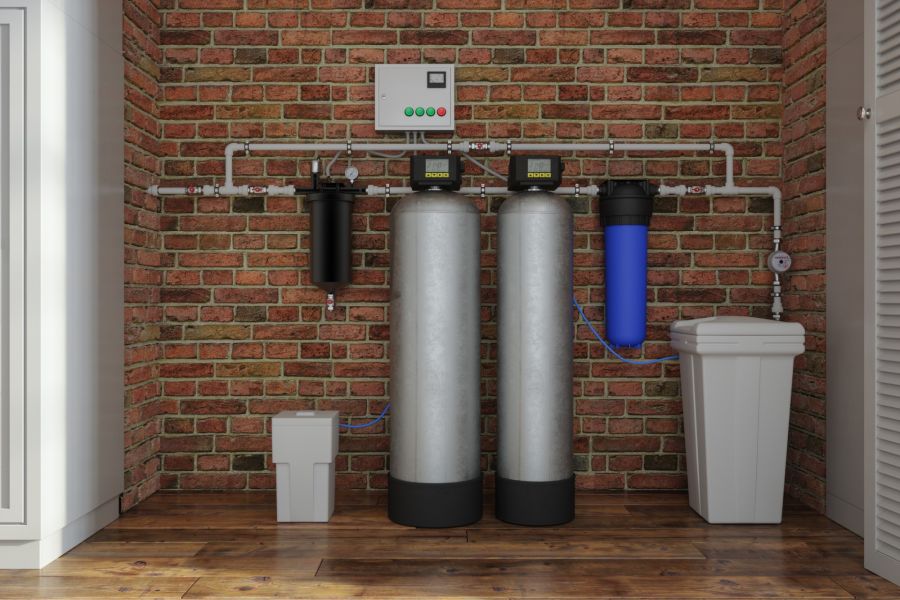
Oxidizing whole-house filters are the most common solution for residential iron removal. Systems using catalytic media, greensand, or Birm media oxidize dissolved ferrous iron on contact, converting it to ferric iron that can then be filtered out. The same media handles manganese. These systems regenerate with potassium permanganate or air injection depending on design.
Iron filter plus softener combinations address both hardness and iron together. The inland Empire's water is hard (see our data on Inland Empire water hardness by city), and many homes dealing with iron staining also deal with scale. A combo system treats both problems through one point-of-entry system.
Air injection systems use a pocket of air held inside the tank to oxidize iron and hydrogen sulfide without chemical regenerants. These are maintenance-friendlier for homeowners who prefer not to handle potassium permanganate.
Reverse osmosis at the kitchen tap removes iron, manganese, and other dissolved solids for drinking and cooking water, though it does not protect plumbing or appliances. It is best used alongside a whole-house iron filter rather than as a standalone solution for high iron concentrations. See our breakdown of reverse osmosis systems for when this option fits.
For San Bernardino County homeowners on city water, a water test from your tap (not just your utility's CCR average) is the right starting point. Distribution system conditions, pipe age, and local well blend ratios can produce iron concentrations at your tap that differ from the utility average. A field test captures your actual exposure.
Schedule a free water test in San Bernardino and we will bring the lab to your tap. Call (949) 873-1129 to book.