Last Updated: August 27, 2026
Gilbert, AZ draws drinking water primarily from the Central Arizona Project (CAP) canal, which carries Colorado River water 336 miles from Lake Havasu, and from Salt River Project (SRP) surface water supplies. The blend typically produces tap water measuring 13 to 17 grains per gallon of hardness and total dissolved solids ranging from 450 mg/L in winter to 700 mg/L or above in summer as canal water concentrates through evaporation. Gilbert Water Division uses chloramine for disinfection, which is stable across the utility's long pipe network but does not dissipate without specific filtration. The City publishes an annual Consumer Confidence Report (CCR) with full contaminant data as required under 40 CFR Part 141, Subpart O. This guide breaks down what that data means for your appliances, plumbing, and drinking water, and what a free in-home water test will confirm for your specific address.
Book a free water test in Gilbert to get hardness, TDS, chlorine, iron, and pH readings at your tap. Call (949) 873-1129, and we will work around your schedule.
How hard is the water in Gilbert AZ?
Gilbert tap water tests at 13 to 17 grains per gallon (gpg) on most residential water quality reports. The Water Quality Association classifies anything above 10.5 gpg as very hard. Gilbert sits comfortably in that range on average, and zones served by local groundwater blends can exceed 18 gpg.
Hardness comes from dissolved calcium and magnesium carbonate. CAP water picks up these minerals as the Colorado River travels through the limestone, sandstone, and carbonate rock formations of the Intermountain West before it is diverted at Lake Havasu. SRP surface water carries similar mineral loads from Arizona's own mountain runoff. When the two sources blend in the Gilbert distribution system, the result is water that is consistently hard regardless of which part of town you live in.
What 13 to 17 gpg means in daily life:
- Scale forms on water heater elements within the first year at these levels. A study published by the Battelle Memorial Institute found water heaters operating at 12 gpg or above lose 22 to 29 percent of their thermal efficiency within three years, adding measurable annual energy waste for a typical household. The full Battelle report is available through the Water Quality Research Foundation (wqrf.org).
- Dishwashers develop glass etching and clogged spray arms within months.
- Showerheads and faucet aerators accumulate visible scale within weeks.
- Laundry requires 30 to 50 percent more detergent because hard water neutralizes surfactants before they clean.
Hardness readings vary by neighborhood based on which feeder lines and local groundwater sources serve that zone. A free water test at your Gilbert address gives you the exact gpg for your home rather than a district average.
What does Gilbert tap water contain?
Gilbert tap water meets all EPA Maximum Contaminant Levels (MCLs) as confirmed in the City's annual Consumer Confidence Report. Within those compliant readings, the water contains several parameters that affect taste, appliances, and plumbing.
Hardness minerals. Calcium carbonate and magnesium carbonate drive the 13 to 17 gpg reading. These are the primary cause of scale in water heaters, pipes, and fixtures throughout Gilbert.
Total dissolved solids. TDS measures the total concentration of dissolved minerals and salts. Gilbert water typically runs 450 to 700 mg/L, with summer peak values near the top of that range. The EPA does not set an MCL for TDS, but the secondary maximum contaminant level recommendation is 500 mg/L. Above 500 mg/L, many people notice a flat or slightly salty taste. A reverse osmosis system in Gilbert reduces TDS to under 50 mg/L at the kitchen tap.
Chloramine. Gilbert Water Division uses chloramine (a combination of chlorine and ammonia) as its residual disinfectant rather than free chlorine. The choice is common across the Phoenix East Valley because chloramine remains stable over long distribution distances and produces fewer regulated disinfection byproducts called trihalomethanes (THMs). The tradeoff is that chloramine does not evaporate from a glass of water left on the counter overnight. Catalytic carbon filtration or a whole house water filtration system in Gilbert is needed to meaningfully reduce it.
Sodium. Sodium enters Gilbert water primarily through the CAP supply, which carries trace sodium from the Colorado River watershed. Sodium levels in CAP water are typically in the 80 to 120 mg/L range depending on the season and delivery conditions. The current City of Gilbert CCR is available on the City website and provides the most current measured values.
Nitrates. The EPA sets a primary MCL for nitrate at 10 mg/L as nitrogen. Gilbert water consistently tests well below this threshold. Annual CCR data confirms compliance. If your property has a private well rather than city water, annual testing for nitrates is advisable because agricultural and septic sources in Maricopa County can affect local groundwater.
PFAS. Under the EPA's PFAS National Primary Drinking Water Regulation finalized in April 2024 (epa.gov/sdwa/pfas), public water systems including Gilbert are required to test for six PFAS compounds. The MCLs for PFOA and PFOS are set at 4 parts per trillion. Large systems like Gilbert began initial monitoring in 2024, with compliance dates phasing in through 2027. Published CCR data and the EPA SDWIS database at enviro.epa.gov are the sources to check for current Gilbert PFAS readings.
Does Gilbert water spike in TDS and taste in summer?
Yes. Gilbert water, like all Central Arizona Project-fed communities, experiences a measurable TDS increase between June and September each year.
The mechanism is evaporation along the CAP delivery route. The CAP main canal runs 336 miles from Lake Havasu to Tucson, open to Arizona's summer heat and low humidity. As water evaporates from the canal surface, the dissolved minerals that remain behind concentrate into the decreasing water volume. The same calcium, magnesium, sodium, and bicarbonate load that was dissolved in 1,000 gallons of March water may be dissolved in 900 gallons by August, pushing TDS from 450 mg/L toward 700 mg/L.
For Gilbert residents, this produces a noticeable change in tap water taste during summer. Water that was tolerable in spring develops a flat, slightly salty character that many residents find unpleasant. The same pattern affects neighboring East Valley cities including Chandler, Mesa, Tempe, and Scottsdale. For a broader look at this seasonal pattern across the Phoenix metro and comparisons to Las Vegas, see the article on summer salty water in Phoenix and Las Vegas.
A reverse osmosis drinking water system in Gilbert removes the TDS variability entirely by filtering water through a semi-permeable membrane that reduces dissolved solids to under 50 mg/L year round, regardless of what the CAP supply looks like in August.
What does a free home water test measure in Gilbert?
A free in-home water test from our Gilbert team checks these parameters at your specific tap, not at the utility's distribution monitoring point:
Hardness (gpg). Measures calcium and magnesium concentration. At 13 to 17 gpg, this is the result that most directly predicts appliance lifespan and cleaning product use in your home. A softener sized correctly for your household's daily water use and your hardness reading eliminates scale at the point of entry.
Total dissolved solids (mg/L). Measured with a calibrated TDS meter at the kitchen tap. Shows the full dissolved mineral load, including whatever seasonal variation has occurred by the date of the test. A reading above 500 mg/L confirms the case for a reverse osmosis drinking water system.
Chloramine presence. Colorimetric test strips or reagents confirm chloramine presence at your tap. Combined with hardness and TDS data, this guides the recommendation for whole house carbon filtration.
Iron (ppm). Iron is not a primary concern in most of Gilbert's city water zones, but homes with private wells or on certain local groundwater supply should test for it. At concentrations above 0.3 mg/L, iron causes reddish-orange staining in sinks, toilets, and laundry. Point-of-entry whole-house filtration with an iron-rated stage addresses this.
pH. Gilbert water typically runs slightly alkaline at 7.5 to 8.2. pH affects how corrosive water is to copper pipes and how well disinfection works, and it factors into which filter media performs best for your system.
Free water test scheduling. You can book a free Gilbert water test online or call (949) 873-1129. Appointments are available throughout Gilbert, including neighborhoods near Val Vista, Higley, Power Road, and the SanTan Village corridor.
Should Gilbert homeowners get a whole house water filter?
Most Gilbert households benefit from whole house filtration, and most benefit even more from pairing it with a water softener. Here is the reasoning by system type.
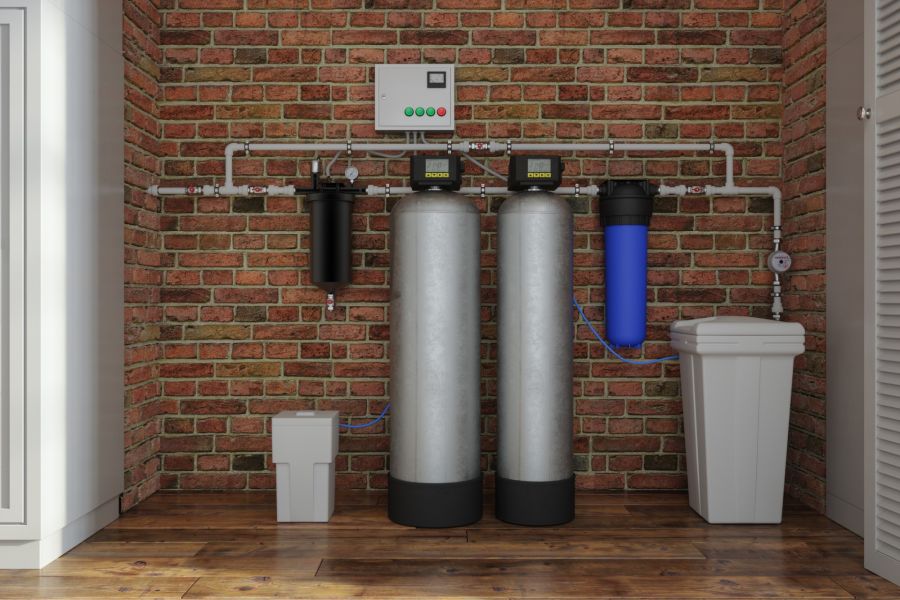
Whole house catalytic carbon filter. Addresses chloramine, taste, odor, and volatile organic compounds at the point of entry before water reaches any faucet, shower, or appliance. Catalytic carbon is specifically designed to break the chloramine bond, which standard activated carbon handles poorly. This is the minimum recommended addition to any Gilbert home on city water. See whole house water filtration options for Gilbert for current equipment options.
Water softener. Addresses the hardness problem at the point of entry. Ion exchange resin swaps calcium and magnesium ions for sodium ions, stopping scale before it enters your water heater, dishwasher, pipes, and showerheads. A correctly sized softener for a Gilbert home with three to four occupants at 13 to 17 gpg hardness typically runs 40,000 to 48,000 grain capacity. See water softeners in Gilbert for equipment options and a free quote.
Combo system (softener plus carbon filter). The most popular configuration in the East Valley because it handles both hardness and chloramine in a single system. View Gilbert combo systems for options and a free quote.
Reverse osmosis drinking water system. Addresses TDS, remaining trace contaminants, and taste at the kitchen tap. RO membranes remove 95 to 99 percent of TDS, chloramine, and most regulated contaminants including PFAS. Most Gilbert households use a 5 or 6 stage under-sink system for drinking and cooking. The whole house softener and carbon filter upstream extends RO membrane life by reducing the mineral and chemical load the membrane must handle. See reverse osmosis systems in Gilbert.
How does Gilbert water compare to other Phoenix East Valley cities?
Gilbert, Chandler, Mesa, Tempe, and Scottsdale all draw from the same CAP and SRP supply sources. Check your own city's annual water quality report for the disinfectant it uses; the City of Mesa's 2025 report, for example, lists chlorine, with chlorine dioxide also used at its Val Vista and Brown Road plants. Water quality differences between these cities are real but relatively modest because they share the same upstream source.
Gilbert's hardness range of 13 to 17 gpg aligns closely with Chandler's 12 to 16 gpg documented in the Chandler water quality guide. Scottsdale's eastern zones run similarly. Mesa water data published in the City of Mesa annual Consumer Confidence Report shows comparable TDS and hardness readings, consistent with drawing from the same regional supply system.
The meaningful differences come from local groundwater blend ratios. Gilbert, like other East Valley cities, supplements CAP and SRP surface water with local groundwater during peak demand periods or when surface water is limited. Local groundwater in Maricopa County's East Valley tends to carry higher hardness and TDS than surface water because it has longer contact time with local mineral-bearing rock formations. Homes in neighborhoods where groundwater blending is higher tend to see readings at the upper end of the 13 to 17 gpg range.
The Phoenix AZ water quality guide covers how the metro supply system works at a regional level, including how SRP and CAP blend ratios shift seasonally.
What is the City of Gilbert water quality report?
The City of Gilbert Water Division publishes a Consumer Confidence Report (CCR) annually as required by EPA regulations under 40 CFR Part 141, Subpart O. The report must be delivered to customers by July 1 each year and filed with the Arizona Department of Environmental Quality.
The CCR is the primary public document for Gilbert water quality. It lists every regulated contaminant tested during the year, the detected level, the regulatory limit (MCL), and the likely source of each contaminant. It covers primary MCL contaminants (those with health-based limits), secondary MCL contaminants (aesthetic parameters like hardness, TDS, and iron), and unregulated contaminants monitored under the EPA's Unregulated Contaminant Monitoring Rule.
Key parameters to look at in the Gilbert CCR:
Hardness. Look at the source water hardness data and the finished water entry. The difference reflects treatment. Most East Valley cities do not soften at the utility level, so hardness in finished water is close to source water hardness.
Total trihalomethanes (TTHMs) and haloacetic acids (HAA5). These are disinfection byproducts that form when chloramine or chlorine reacts with organic matter in source water. EPA MCLs are 80 ppb for TTHMs and 60 ppb for HAA5s. Gilbert's levels are published in the CCR.
Nitrates. Compared against the 10 mg/L MCL. Relevant if you draw any water from a private well.
PFAS. Beginning in 2024, Gilbert is required to test for six PFAS compounds under the new EPA rule. CCR and SDWIS database entries will reflect initial monitoring results.
The Arizona Department of Environmental Quality hosts CCRs at azdeq.gov/environ/water/dw/ccr.html. You can also search the EPA's Environmental Information database at enviro.epa.gov by entering "Gilbert" and Arizona to locate the current SDWIS record for the City of Gilbert water system.
Take the next step for Gilbert water quality
Gilbert water meets all Safe Drinking Water Act standards. That is the right baseline. But hard water at 13 to 17 gpg shortens appliance life and increases energy and cleaning product costs measurably, and chloramine in an open glass will still be there tomorrow morning.
A free home water test gives you numbers for your specific address rather than a district average. From that data, we size the right system for your home, whether that is a softener, a whole house carbon filter, a combo system, or a reverse osmosis unit at the kitchen tap.
Three ways to get started:
Water quality data referenced from: City of Gilbert Consumer Confidence Reports; Arizona Department of Environmental Quality CCR portal (azdeq.gov); EPA SDWIS database (enviro.epa.gov); EPA PFAS National Primary Drinking Water Regulation (epa.gov/sdwa/pfas); Battelle Memorial Institute water heater efficiency study, available through the Water Quality Research Foundation (wqrf.org). Verify current readings against the most recent published CCR for your water system before making treatment decisions.