Scottsdale draws approximately 95 percent of its tap water from the Central Arizona Project (CAP), which delivers Colorado River water across Arizona. CAP water is classified as very hard by the USGS national hardness map, with hardness typically ranging from 230 to 270 mg/L as calcium carbonate, equivalent to approximately 13 to 16 grains per gallon. Total dissolved solids in CAP water commonly run 550 to 700 mg/L and can reach 650 to 750 mg/L during peak summer months when heat concentrates minerals in the Colorado River system. The EPA secondary standard for TDS is 500 mg/L, a threshold Scottsdale's supply frequently exceeds due to natural mineral content rather than treatment failure. Scottsdale Water serves approximately 240,000 connections across Scottsdale and surrounding areas. For homeowners in this part of the Phoenix metro, these water quality characteristics translate directly to visible scale on fixtures, shortened water heater lifespans, and drinking water that many families choose to treat at the tap.
Schedule a free water test for your Scottsdale home. Call us at (949) 873-1129.
Where Scottsdale water comes from: the Central Arizona Project
Scottsdale Water is the municipal utility serving approximately 240,000 connections across Scottsdale and portions of the surrounding Phoenix metro. Unlike cities that rely on local wells or reservoir systems, Scottsdale draws approximately 95 percent of its supply from the Central Arizona Project (CAP), according to the City of Scottsdale 2023 Consumer Confidence Report (available at scottsdaleaz.gov/water).
The Central Arizona Project is a 336 mile canal system that lifts Colorado River water from Lake Havasu and delivers it across central and southern Arizona. CAP is the largest water delivery system in Arizona and serves approximately 80 percent of Arizona's population either directly or through recharged groundwater. Water quality data is published by the Central Arizona Project at cap-az.com.
The Colorado River accumulates dissolved minerals throughout its long path through calcium rich sedimentary rock formations. By the time that water reaches Arizona, it carries high concentrations of calcium, magnesium, sodium, sulfate, and other dissolved solids. This is why CAP water is fundamentally different from the soft water found in Pacific Northwest cities drawing from granite dominated watersheds where mineral dissolution is minimal.
Scottsdale water hardness: what the numbers mean
Hardness is measured in milligrams per liter (mg/L) of calcium carbonate equivalent, or converted to grains per gallon (gpg) for household reference. The Water Quality Association classifies water above 180 mg/L (greater than 10.5 gpg) as very hard.
CAP water hardness typically ranges from 230 to 270 mg/L (approximately 13 to 16 gpg) depending on season and Colorado River conditions, based on water quality data published by the Central Arizona Project. The USGS Circular 1352, "Water Hardness in the United States," classifies the Phoenix-Scottsdale metro area as very hard, the highest classification on the national hardness map (usgs.gov).
For comparison, water is considered moderately hard at 60 to 120 mg/L, hard at 120 to 180 mg/L, and very hard above 180 mg/L. Scottsdale tap water comes in at the upper range of the very hard category.
| Hardness Classification | mg/L (as CaCO3) | Grains per Gallon |
|---|
| Soft | 0 to 60 | 0 to 3.5 |
| Moderately Hard | 60 to 120 | 3.5 to 7 |
| Hard | 120 to 180 | 7 to 10.5 |
| Very Hard | 180+ | 10.5+ |
| Scottsdale CAP Typical | 230 to 270 | 13 to 16 |
Source: Water Quality Association classification scale; CAP water quality data.
Scottsdale TDS levels and the EPA secondary standard
Total dissolved solids (TDS) is the combined measurement of all inorganic and organic substances dissolved in water. The EPA sets a secondary standard for TDS at 500 mg/L based on taste and aesthetic concerns rather than health risk. It is not legally enforceable.
CAP water delivered to Scottsdale commonly measures 550 to 700 mg/L under typical conditions. During peak summer months, when high temperatures increase evaporation rates and Colorado River flow volumes are reduced, TDS in CAP supply can reach 650 to 750 mg/L. This seasonal variation is documented in CAP water quality monitoring data (cap-az.com).
Exceeding the EPA secondary standard for TDS is not a violation. Secondary standards are guidelines for taste, odor, and aesthetic qualities rather than health based limits. Scottsdale Water is legally in compliance when delivering water above 500 mg/L TDS. However, some households find the mineral taste noticeable, particularly for drinking and cooking water, which is one reason point of use reverse osmosis systems are common in the Phoenix metro area.
Summer TDS spikes: seasonal variability in Scottsdale water
Scottsdale homeowners sometimes notice changes in water quality between seasons. The primary driver is the Colorado River itself: summer heat causes greater evaporation from Lake Mead and Lake Havasu, concentrating dissolved minerals in the water that remains. Lower snowpack years, which have become more frequent, also reduce total river flow, which further concentrates dissolved solids.
The practical result is that Scottsdale tap water at the height of summer often measures at the higher end of the 550 to 750 mg/L TDS range, while late winter and spring water from adequate snowpack years may run closer to 550 mg/L.
| Season | Typical TDS Range (mg/L) | Notes |
|---|
| Winter / Spring | 550 to 620 | Higher river flow, lower evaporation |
| Summer | 650 to 750 | Evaporation peak, low river flow |
| Fall | 580 to 660 | Transitional |
Source: Central Arizona Project water quality data, cap-az.com.
Arsenic and other contaminants in Scottsdale water
Arizona has naturally elevated arsenic concentrations in portions of its groundwater due to volcanic geology. The EPA maximum contaminant level for arsenic is 10 parts per billion (ppb). Scottsdale's supply chain runs primarily through CAP surface water rather than local groundwater wells, which reduces (but does not eliminate) arsenic exposure compared to some Arizona well water systems.
Scottsdale Water is required by the EPA Safe Drinking Water Act to test for arsenic and all primary contaminants. Current test results are reported annually in the Consumer Confidence Report, available at scottsdaleaz.gov/water. The Arizona Department of Environmental Quality (ADEQ) also maintains water quality data at azdeq.gov.
On PFAS: Scottsdale's supply chain primarily runs through CAP surface water, which has lower PFAS levels than contaminated groundwater systems documented in some other Arizona communities. EPA UCMR5 monitoring data for Scottsdale Water is searchable at epa.gov/dwucmr and shows no alarming PFAS levels in the CAP supply specifically, though ongoing monitoring under the 2024 EPA PFAS National Primary Drinking Water Rule is required.
What very hard water does in a Scottsdale home
At 13 to 16 grains per gallon, Scottsdale tap water causes measurable impacts on household systems and fixtures over time.
Scale buildup is the most visible consequence. Calcium and magnesium deposits accumulate inside water heaters, pipes, dishwashers, and ice makers. A water heater with significant scale requires more energy to heat the same volume of water, increasing operating costs (U.S. Department of Energy efficiency data: energy.gov/energysaver). Showerheads and faucet aerators develop visible buildup within months rather than years at these hardness levels.
Soap and detergent performance suffers in hard water because calcium and magnesium interfere with lathering. Laundry may feel stiff and look dull. Glassware and dishes develop spots after drying. Skin and hair feel dry after showering in very hard water.
These are physical and economic impacts rather than health concerns. Water hardness at typical Scottsdale levels is not a health risk under EPA and WHO guidelines. The question for homeowners is whether the cost of scale damage and detergent inefficiency justifies water treatment, and for most Scottsdale households with 13 to 16 gpg water, the math favors treatment.
Treatment options for Scottsdale water quality
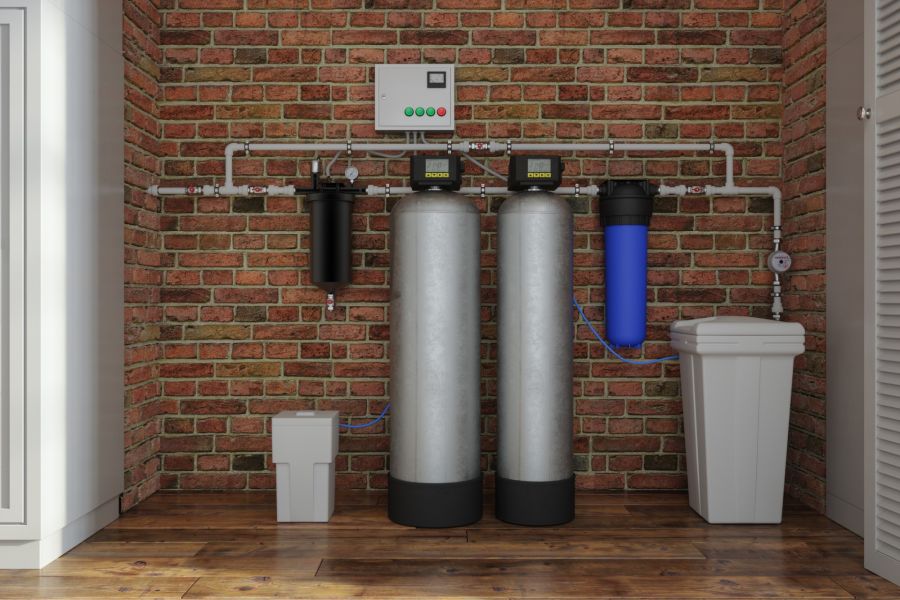
For hardness: A salt based water softener using ion exchange is the standard treatment for water in the 13 to 16 gpg range common in Scottsdale. It exchanges calcium and magnesium ions for sodium, eliminating scale and soap film throughout the whole house. Salt free conditioners or template assisted crystallization systems are alternatives for households wanting to avoid sodium addition, though they do not reduce measured hardness.
For TDS and drinking water quality: A point of use reverse osmosis system certified to NSF/ANSI Standard 58 reduces TDS at the kitchen tap by 90 to 95 percent, bringing Scottsdale's 550 to 750 mg/L supply down to the 30 to 60 mg/L range that most people find clean and neutral in taste. RO also reduces arsenic, nitrates, dissolved pharmaceuticals, and most other ionic contaminants.
For combined hardness and drinking water concerns: The most common combination in the Phoenix metro area is a whole house water softener paired with a point of use reverse osmosis system. The softener protects appliances and fixtures throughout the home. The RO unit provides high quality drinking and cooking water at the tap. These systems operate independently and can be used together.
We serve Scottsdale, Phoenix, Chandler, Mesa, Tempe, Gilbert, and throughout the Phoenix metro area. We start every consultation with a free water test at your tap so we can show you exactly what is in your water before recommending anything.
Get a free water test for your Scottsdale home. Call (949) 873-1129 or book online.