Mesa, Arizona gets its tap water from two surface water sources and from groundwater wells, and the zone you live in decides which surface water you receive. According to the City of Mesa's 2025 Water Quality Consumer Confidence Report (issued 2026), the City Zone is served by Salt and Verde River water delivered through the Salt River Project, and the Eastern and Southern Zones are served by Colorado River water delivered through the Central Arizona Project. Average hardness is about 12 grains per gallon in the City Zone and 16 grains per gallon in the Eastern and Southern Zones, which is very hard on the USGS scale. Mesa disinfects with chlorine, and its Val Vista and Brown Road plants also use chlorine dioxide. This guide summarizes what the report shows and what it means for treatment at home.
Schedule a free water test for your Mesa home. Call us at (949) 873-1129.
Where Mesa gets its water, by zone
The City of Mesa divides its service area into three zones: the City Zone, the Eastern Zone and the Southern Zone. The 2025 report describes the sources this way:
- City Zone: Salt River Project water. Salt and Verde River water is treated at the Val Vista Water Treatment Plant with conventional filtration, fluoridation, and disinfection with chlorine dioxide and chlorine. About 40 percent of the water Mesa served in 2025 came from this source.
- Eastern and Southern Zones: Central Arizona Project water. Colorado River water is treated at the Brown Road and Signal Butte Water Treatment Plants. About 52 percent of the water Mesa served in 2025 came from this source.
- Groundwater wells. Eighteen deep wells serve the City Zone and sixteen serve the Eastern and Southern Zones. After chlorination, well water is blended with surface water. Each group of wells supplied about 4 percent of the water served in 2025.
The report adds that all zones may receive groundwater, or a blend of surface water and groundwater, at different times of the year. That is one reason a reading at your own tap can differ from the zone average.
Source: City of Mesa 2025 Water Quality Consumer Confidence Report.
How hard is Mesa's tap water?
Hardness is measured in milligrams per liter as calcium carbonate (mg/L) or in grains per gallon (gpg). One grain per gallon equals 17.1 mg/L. The USGS classification:
| Hardness level | mg/L as calcium carbonate |
|---|
| Soft | 0 to 60 |
| Moderately hard | 61 to 120 |
| Hard | 121 to 180 |
| Very hard | more than 180 |
Source: USGS Water Science School.
The City of Mesa's report gives these figures:
| Measure | City of Mesa 2025 report |
|---|
| City Zone average hardness | about 12 gpg |
| Eastern and Southern Zones average hardness | 16 gpg |
| Hardness range, all samples | 6.6 to 433 mg/L (0.4 to 25 gpg) |
| Recommended softener setting | 16 gpg, then adjust to preference |
At 12 gpg (about 205 mg/L) and 16 gpg (about 274 mg/L), both zone averages are above the 180 mg/L line for very hard water. The wide range comes from the mix of surface water and groundwater a given address receives at a given time.
Water this hard leaves scale on water heater elements, faucet aerators, showerheads and glass, and it makes soap and detergent less effective. To find your own zone, use the zone map in the city's report, or get a reading at your tap with a free water test.
Disinfection: chlorine and chlorine dioxide
The City of Mesa's report lists chlorine and chlorine dioxide as its disinfectants. The Val Vista and Brown Road plants use chlorine dioxide and chlorine, the Signal Butte plant uses ozone and chlorine, and well water is chlorinated before it is blended.
| Disinfectant | Highest level reported | Range | Limit (MRDL) |
|---|
| Chlorine | 0.65 ppm (running annual average) | 0.02 to 2.04 ppm | 4 ppm |
| Chlorine dioxide | 150 ppb | below 20 to 150 ppb | 800 ppb |
Chlorine is what most people notice as a pool-like taste or smell. A carbon filter certified for chlorine taste and odor reduction handles it at the kitchen tap, and a whole house carbon filter handles it at every fixture.
Arsenic and nitrate
The report explains that some of Mesa's sources contain low levels of naturally occurring arsenic. The highest arsenic level detected in 2025 was 8.8 ppb, with results from 0.8 to 8.8 ppb, against the federal maximum contaminant level of 10 ppb. The highest nitrate level was 8.99 ppm, with results from not detected to 8.99 ppm, against a limit of 10 ppm.
Both results were below their limits. For homeowners who want lower levels at the drinking water tap, a reverse osmosis system certified for arsenic and nitrate reduction is the usual choice. Check the product's certification listing for the specific contaminants it is certified to reduce.
Total dissolved solids and sodium
The report's hardness table lists total dissolved solids from 190 to 970 mg/L (sampled in 2022) and sodium from 45 to 212 mg/L. Total dissolved solids is the combined amount of minerals and salts in the water. Higher levels do not make water unsafe, but they change the taste and leave spots on glass and fixtures.
An under-sink reverse osmosis system lowers dissolved solids and sodium in drinking and cooking water. A water softener does not lower dissolved solids; it swaps hardness minerals for sodium or potassium.
Disinfection byproducts
Disinfection byproducts form when disinfectants react with natural organic matter in source water. The City of Mesa's report lists:
| Byproduct | Highest locational running annual average | Range | EPA MCL |
|---|
| Total trihalomethanes (TTHM) | 57 ppb | not detected to 64.09 ppb | 80 ppb |
| Haloacetic acids (HAA5) | 25 ppb | not detected to 19.6 ppb | 60 ppb |
Both were below their limits in 2025. Carbon filtration and reverse osmosis systems certified for these byproducts reduce them at the tap.
What treatment options match Mesa's water
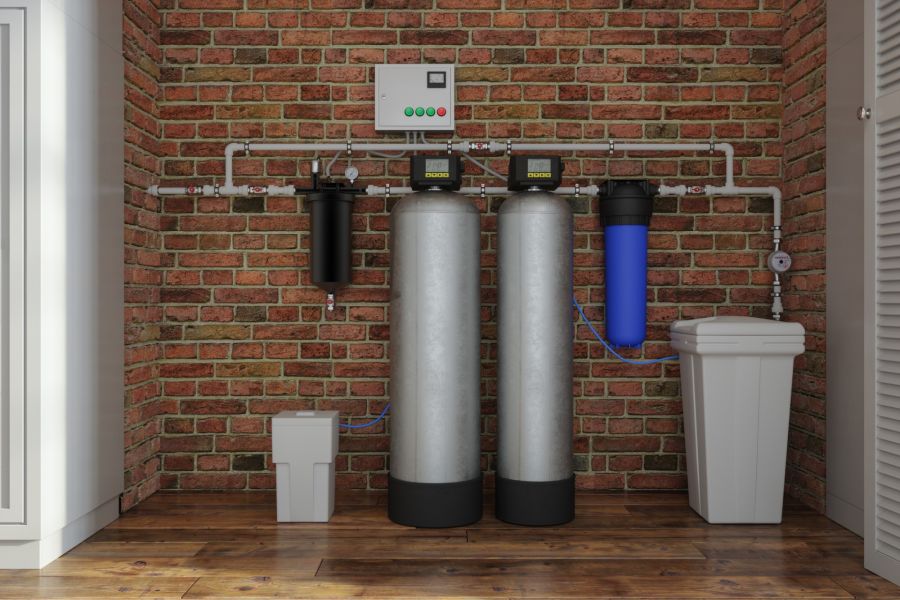
Whole home hardness and scale: A salt-based water softener is the standard treatment for very hard water. The city suggests a 16 gpg setting as a starting point. Softener sizing also depends on your household's daily water use, so a reading at your tap before purchase avoids over-sizing or under-sizing the resin tank.
Drinking and cooking water: An under-sink reverse osmosis system lowers hardness, dissolved solids, sodium, arsenic and nitrate in the water you drink, and its carbon stages remove chlorine taste.
Whole home taste and odor without softening: A whole house carbon filter reduces chlorine at every fixture for homeowners who want that without salt-based softening.
The right combination depends on your zone and what your water shows at your address. A free water test is the starting point.
How to read the City of Mesa's water quality report
The City of Mesa publishes its Water Quality Consumer Confidence Report each year at mesaaz.gov/water. The 2025 report, issued in 2026, lists each detected regulated contaminant with its highest level, its range, the limit and the likely source. "ND" means not detected. The report also includes a zone map and a water hardness table.
For PFAS, the report says Mesa completed EPA's fifth Unregulated Contaminant Monitoring Rule (UCMR 5), which covered 29 PFAS compounds and lithium from January 2023 to December 2025. Results are published in EPA's UCMR 5 data finder.
Get a free water test for your Mesa, AZ address. We serve the Phoenix metro including Mesa, Chandler, Gilbert, Scottsdale, and surrounding cities.