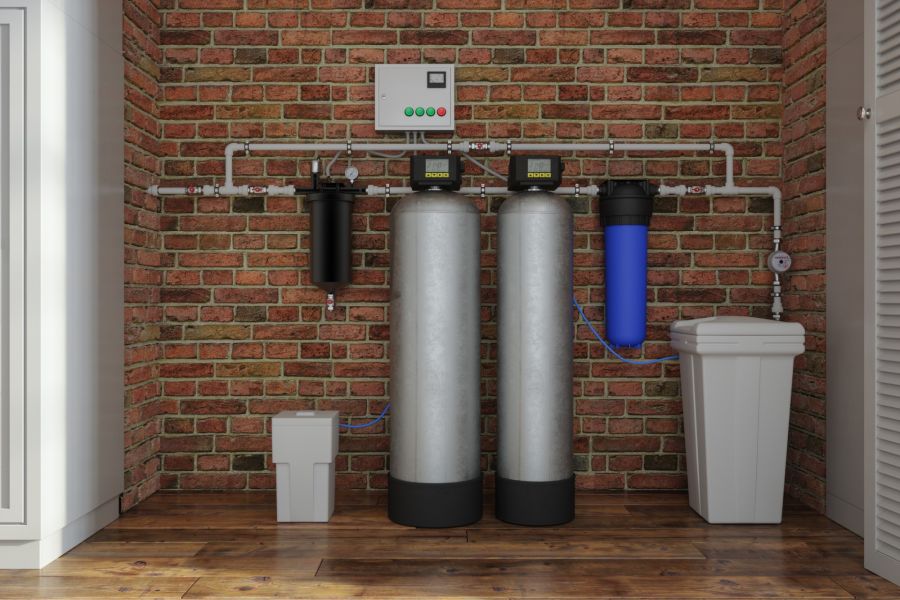
Anaheim Hills is served by Anaheim Public Utilities, the city-owned utility. The city states that Walnut Canyon Reservoir "serves as a primary source of water to the Anaheim hill-and-canyon areas" (City of Anaheim, Walnut Canyon Reservoir), and that the reservoir holds imported Metropolitan Water District (MWD) water that is treated at the Lenain Treatment Plant before delivery. In the Anaheim Public Utilities 2026 Water Quality Report (based on 2025 data), Lenain-treated water averaged 17 grains per gallon of total hardness, and detections across all Anaheim sources ranged from 9 to 25 grains per gallon. The Water Quality Association classifies water above 10.5 gpg as very hard. The same report states: "Anaheim Public Utilities uses chlorine to disinfect the water served to our customers." Free chlorine is removed by standard activated carbon, which is different from chloramine. This guide covers what Anaheim Public Utilities delivers, the impact of hardness on your appliances, and what treatment options exist for an Anaheim Hills home. Softeners are permitted here with no ban.
What is the water quality in Anaheim Hills CA?
Anaheim Hills water is very hard, averaging about 17 grains per gallon on the Lenain-treated supply, and is disinfected with chlorine. Source: Anaheim Public Utilities 2026 Water Quality Report. Read the current report for compliance details.
Anaheim Public Utilities draws on several sources. Per the same report, the table lists separate averages for groundwater (18 gpg), Lenain-treated imported water (17 gpg) and MWD supply (14 gpg), so the hardness at your tap depends on which source is feeding your zone. For the hill-and-canyon areas, the city says Walnut Canyon Reservoir is a primary source (City of Anaheim). Your water bill or the utility can tell you which source serves your address.
Beyond hardness, the disinfectant matters for filtration choices. The Anaheim Public Utilities 2026 Water Quality Report states that Anaheim Public Utilities uses chlorine to disinfect the water served to customers. Free chlorine can cause a chlorine taste and odor, and standard activated carbon removes it, so a basic carbon filter is an appropriate taste and odor fix here. If you move to a utility that uses chloramine, check its report, because chloramine needs catalytic carbon instead.
Total dissolved solids (TDS) varies by source, pipe run and plumbing age. The only way to know the number at your tap is to measure it. If your kitchen tap reads high on a test strip, have a hardness and TDS test done to see whether the cause is the supply or your own plumbing.
To get a precise baseline for your address, schedule a free water test in Anaheim Hills. We test hardness, chlorine, TDS, and pH at your tap and give you recommendations based on your results.
How hard is the water in Anaheim Hills?
Anaheim Public Utilities reported an average of 17 grains per gallon (gpg) for Lenain-treated water in its 2026 Water Quality Report, which the Water Quality Association classifies as very hard. Detections across all Anaheim sources ranged from 9 to 25 gpg, so check your own tap.
To frame what about 17 gpg means in practice: the Water Quality Association defines water as hard above 7 gpg and very hard above 10.5 gpg. Anaheim Hills water exceeds the very hard threshold by a wide margin.
The practical consequences accumulate in predictable ways. Water heaters at this hardness develop scale inside the tank and on the heating element, and scale on a heating element raises the energy needed to heat the same volume of water. Tankless water heaters are more vulnerable still, because their narrow heat exchanger passages are where scale concentrates.
Fixtures and appliances throughout the home show the same pattern. Dishwasher spray arms accumulate scale that reduces spray pressure over one to two years. Showerheads drop from 2.5 gallons per minute to under 1.5 gallons per minute as orifices restrict with deposits. Glass shower doors develop a permanent white haze that cleaning does not fully reverse once mineral deposits etch into the glass surface.
For a broader look at how Anaheim Hills hardness compares to neighboring communities across the region, see our Orange County hard water guide. For softener sizing by hardness level and household size, the Orange County water softener guide covers the full decision framework.
Know your exact number before you buy anything. Book a free water test or call (949) 873-1129 and we will bring a calibrated meter to your home at no charge.
Who supplies water to Anaheim Hills?
Anaheim Public Utilities, a city-owned utility, is the water supplier for Anaheim Hills. The city says Walnut Canyon Reservoir "serves as a primary source of water to the Anaheim hill-and-canyon areas" (City of Anaheim). That reservoir receives imported, untreated Colorado River water from the Metropolitan Water District, and the water is treated at the August F. Lenain Treatment Plant before delivery, according to the same page.
Anaheim and Anaheim Hills are served by the same utility, Anaheim Public Utilities, so the same annual water quality report covers both. Source mix differs by zone: the city says most of Anaheim is served by groundwater wells, while the hill-and-canyon areas rely on Walnut Canyon Reservoir.
The Anaheim Public Utilities 2026 Water Quality Report lists total hardness of 18 gpg for groundwater, 17 gpg for Lenain-treated water and 14 gpg for MWD supply, with a range of detections from 9 to 25 gpg.
Anaheim Public Utilities publishes an annual water quality report covering tested parameters and comparisons to EPA and state limits. Read the current report at anaheim.net/2092, or download the 2026 report PDF.
One boundary note: some properties near the edge of the Anaheim Hills community, particularly those bordering neighbouring cities, may fall in a different water district. If you are unsure which utility serves your address, check your water bill before booking any service. We verify service area before every appointment.
Does Anaheim Hills have good tap water?
Anaheim Hills tap water is served by Anaheim Public Utilities, which publishes an annual water quality report (anaheim.net/2092). Read the current report for compliance results. Most homeowners who treat their water do so for taste, hardness reduction, and chlorine removal.
"Safe" and "ideal" describe different things in water quality. Federal and state regulations set legally enforceable maximum contaminant levels for dozens of regulated substances, and the utility reports its results annually. Hardness is not a health standard, so treatment decisions are about comfort and property protection.
The quality concerns that lead Anaheim Hills homeowners to treat their water sit in a separate category. Hardness at about 17 gpg causes property damage, not health harm. It shortens appliance lifespans, deposits scale on fixtures, and reduces the effectiveness of soaps and detergents. Chlorine at standard disinfection concentrations is safe to drink, but some people notice a chlorine taste or smell.
Taste and smell complaints before treatment usually trace to the chlorine residual. Standard activated carbon removes free chlorine. A carbon filter at the point of entry treats the whole house, and an under sink reverse osmosis system treats drinking and cooking water specifically.
For homeowners primarily concerned with drinking water quality, a reverse osmosis system handles chlorine taste, TDS reduction, and trace contaminants in one compact unit. For those who want addressed quality at every shower, faucet, and appliance, a whole house treatment approach covers the full scope. See signs you need whole house water filtration for a detailed look at when point of entry treatment is the right call.
What water treatment do Anaheim Hills homeowners need?
Most Anaheim Hills homes benefit from a whole house water softener sized for about 17 gpg, paired with a carbon filter to remove chlorine taste and odor. Homes with longer pipe runs or older plumbing often add a sediment prefilter as well.
The treatment decision comes down to which problems you are solving. Here is how the options map to the Anaheim Hills water profile.
Salt based water softener only. A properly sized ion exchange softener addresses hardness completely. It does not remove chlorine, improve taste, or filter sediment. For homes where the primary complaint is scale on fixtures, appliance wear, and soap performance, a softener alone handles the main issue. At about 17 gpg, a four person household needs a 48,000 to 64,000 grain capacity unit. Our full setup guide is at water softeners in Anaheim Hills.
Combo softener plus carbon. The softener handles hardness through ion exchange; the carbon stage handles chlorine taste and odor. Both units are sized as a matched pair and share a single bypass valve. This combination addresses both main water quality complaints for the area in one system. See combo systems in Anaheim Hills for current package options.
Combo plus reverse osmosis. For households that also want low TDS drinking water, adding an under sink RO unit to the softener plus carbon setup covers the full range. The RO delivers water at under 50 ppm TDS for cooking and drinking. For the filtration side of this setup, whole house water filtration in Anaheim Hills covers media selection and sizing.
For homes showing elevated iron or sediment from older supply lines, common in Anaheim Hills housing stock built in the 1970s and 1980s, a sediment prefilter protects the softener resin bed and extends service intervals.
Ready for a system recommendation specific to your home? Call (949) 873-1129 and we will discuss your complaints, your home size, and your goals before recommending anything.
How do I get a quote for a water softener in Anaheim Hills?
Every home is different. System size, site conditions, and plumbing configuration all affect the recommendation. Hillside homes in Anaheim Hills often have unique utility room clearance or supply line run considerations that require a physical assessment before any firm recommendation can be made.
Here is the 2026 breakdown by system type.
| System Type | Best For |
|---|
| 32,000 grain softener | 2 to 3 person homes |
| 48,000 grain softener | 4 person home at 16 gpg |
| 64,000 grain softener | 5 to 6 person or high use homes |
| Combo softener plus carbon | Hardness and chlorine taste treatment |
| Combo plus under sink reverse osmosis | Drinking water purity included |
Hillside properties in Anaheim Hills require a physical site assessment before a firm quote. Utility rooms that were designed for hillside footprints may have limited clearance. Long supply line runs from the street to the garage may require additional pipe. We recommend an assessment at your home before committing to any quote from a provider who has not visited your property. See our water softener maintenance guide for ongoing care.
What is Anaheim Public Utilities water quality like?
Anaheim Public Utilities serves Anaheim Hills with imported MWD water treated at the Lenain plant, plus other city sources, and disinfects with chlorine. Hardness and chlorine taste are the two main treatment considerations for Anaheim Hills customers.
Anaheim Public Utilities is a municipally owned utility that publishes an annual water quality report with all tested parameters and comparisons to EPA maximum contaminant levels. The current report is at anaheim.net/2092.
Key parameters in the Anaheim Public Utilities 2026 Water Quality Report (based on 2025 data): total hardness averaged 18 gpg in groundwater, 17 gpg in Lenain-treated water and 14 gpg in MWD supply, with a range of detections from 9 to 25 gpg; the disinfectant is chlorine. Always verify with the current year report, since levels can shift.
Homes built in the 1970s and 1980s, which make up a significant share of the Anaheim Hills housing stock, may have galvanized or aging copper supply lines that add iron or mineral pickup between the main and the tap. If your water shows a faint rust tint or elevated iron on a test strip, this is likely a pipe issue rather than a change in source water. A sediment prefilter combined with a softener addresses both.
Your next step is straightforward. Schedule a free water test or call (949) 873-1129 and we will come to your home, test your water at the tap for hardness, chlorine, TDS, and pH, and give you recommendations based on your results. No sales pressure, no obligation. We serve all of Anaheim Hills, including Peralta Hills, the Summit communities, and Canyon area homes. See the broader Orange County water softener guide for regional context.