Orange County water hardness varies by city and by which utility serves your block, so there is no single county-wide number. Anaheim and Anaheim Hills are served by Anaheim Public Utilities, whose 2026 report lists averages of 18 gpg for groundwater, 17 gpg for Lenain-treated imported water and 14 gpg for MWD supply, with detections across its sources ranging from 9 to 25 gpg (Anaheim Public Utilities 2026 Water Quality Report). Costa Mesa is served by Mesa Water District on 100 percent local groundwater, which reports an average of 6.6 gpg and a range of 1.2 to 17 (Mesa Water District 2026 Consumer Confidence Report). The Water Quality Association uses 7 gpg as the threshold that defines hard water. Hard water is not a safety concern, but it does measurable damage to appliances, surfaces, and plumbing over time. A water heater at 12 gpg accumulates enough scale to lose 22 to 29 percent of its energy efficiency within three years. Showerheads begin scaling visibly within four to six months. This guide explains what your OC water is costing you and what treatment addresses each problem.
How Hard Is Orange County Tap Water?
Orange County tap water hardness varies by city and utility, and no single figure covers the whole county.
The Orange County Water District manages the groundwater basin beneath northern and central OC, replenished in part through the Groundwater Replenishment System. OCWD water reaches homes in Anaheim, Garden Grove, Santa Ana, Fullerton, and Buena Park, and Anaheim Public Utilities reports a groundwater average of about 18 gpg (Anaheim Public Utilities 2026 Water Quality Report). The Metropolitan Water District of Southern California supplies coastal and western OC cities, including Newport Beach and Huntington Beach, with treated surface water from the Colorado River and Northern California. Anaheim Public Utilities reports its MWD supply averaging 14 gpg, and Mesa Water District reports its Metropolitan column at 14 gpg with a range of 11 to 16 (Mesa Water District 2026 Consumer Confidence Report). For other cities, check that utility's own annual report.
Anaheim Public Utilities, a city-owned utility, serves Anaheim and Anaheim Hills. Anaheim Hills water is imported Metropolitan Water District supply treated at the Lenain plant, which averaged 17 gpg in the Anaheim Public Utilities 2026 Water Quality Report, and the city says Walnut Canyon Reservoir is a primary source for its hill-and-canyon areas (City of Anaheim). IRWD publishes its own annual water quality report, which is the place to check hardness for an Irvine address.
For a full breakdown by city, see our Orange County water treatment guide, which includes a comparison table of utilities, hardness ranges, and treatment recommendations by city.
For specific guidance, visit our pages for Anaheim Hills water softeners and Irvine water softeners.
What Does Hard Water Do to Appliances in Orange County?
Hard water at OC hardness levels causes scale buildup on any surface that heats or holds water. The Battelle Memorial Institute conducted a study for the Water Quality Research Foundation that quantified the efficiency losses from mineral scale on common household appliances. At 12 grains per gallon, water heater efficiency drops 22 to 29 percent within three years, resulting in measurable added energy costs at Southern California utility rates before you factor in early equipment replacement.
Water heaters bear the most severe impact because the heating element sits in direct contact with the water. Every heating cycle deposits a thin mineral layer on the element surface. Over three years of daily use at OC hardness levels, that layer becomes thick enough to act as insulation, forcing the element to work harder and longer to raise water temperature. Gas water heaters see similar effects on the heat exchanger and burner components.
Dishwashers require significantly more detergent in hard water to achieve the same cleaning results. Consumer research puts the increase at 25 to 50 percent more detergent for a family of four compared to softened water households. That difference adds up to meaningful annual savings on cleaning products for softened-water households. The same effect applies to laundry detergent in washing machines.
Showerheads and faucet aerators at 12 gpg or higher develop visible white calcium scale deposits within four to six months. Left untreated, those deposits reduce flow rate noticeably within one to two years and can block aerators entirely. Ice makers, coffee makers, and refrigerator water dispensers all show similar accumulation patterns on any internal water-contacting surface.
Pipes themselves scale more slowly but the effect is permanent in older homes with galvanized or copper supply lines. Scale inside pipe walls reduces diameter over decades and creates rough surfaces that trap sediment and bacteria.
Which Orange County Cities Have the Hardest Tap Water?
Anaheim Public Utilities supply, including Anaheim Hills, averages 18 gpg for groundwater and 17 gpg for Lenain-treated imported water, with detections from 9 to 25 gpg (Anaheim Public Utilities 2026 Water Quality Report). At the other end of the county, Mesa Water District serves Costa Mesa on 100 percent local groundwater and reports an average of 6.6 gpg with a range of 1.2 to 17 (Mesa Water District 2026 Consumer Confidence Report). For cities we have not named here, the hardness figure comes from that utility's own annual report rather than from any county-wide number.
Understanding which city you are in matters because hardness determines the grain capacity you need in a water softener. Using an undersized unit at high hardness levels means the resin bed exhausts between regeneration cycles, allowing hard water to pass untreated into your pipes during that period.
For Anaheim Hills homeowners, the specific water quality characteristics and treatment recommendations are covered in our Anaheim Hills water quality guide. For a broader OC city comparison, see the OC water treatment guide.
Schedule a free water test in Anaheim Hills or free water test in Anaheim to get a calibrated hardness reading from your actual tap.
Does Orange County Water Have Chloramine?
Disinfectant practice varies by utility in Orange County, so the answer depends on your address. Anaheim Public Utilities, which serves Anaheim and Anaheim Hills, states that it "uses chlorine to disinfect the water served to our customers" (Anaheim Public Utilities 2026 Water Quality Report). We have not read the reports for every other utility, so check your own utility's current water quality report for the disinfectant it names. Chloramine, where a utility uses it, is formed by combining chlorine with ammonia. Utilities switched to chloramine across California largely because it is more stable in the distribution system and produces fewer trihalomethanes than free chlorine, a class of disinfection byproducts the EPA regulates under National Primary Drinking Water Regulations. See the EPA drinking water standards for the full regulatory context.
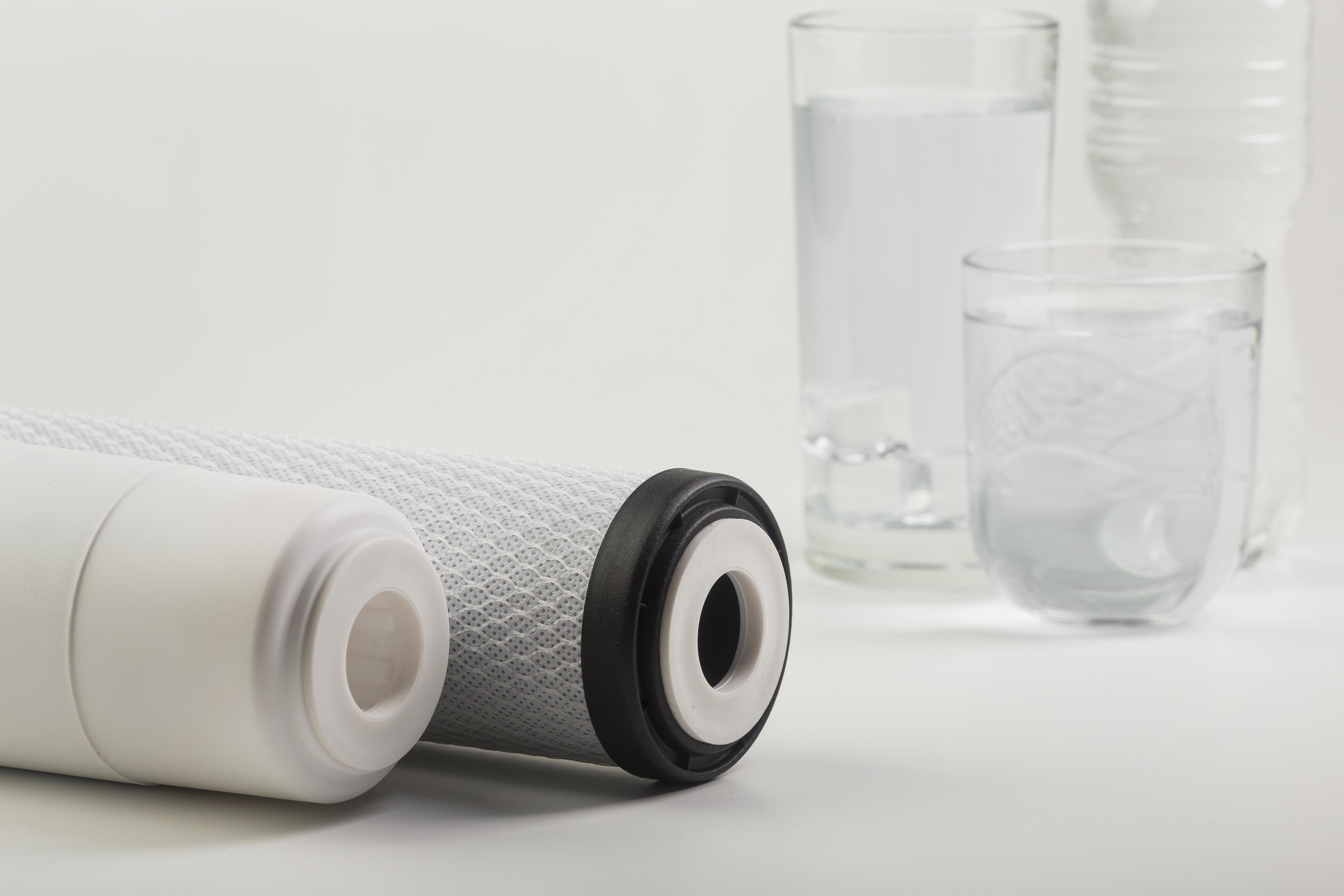
The challenge for homeowners is that chloramine is far harder to remove than free chlorine. Standard activated carbon, the kind found in pitcher filters, most refrigerator filters, and basic whole-house inline carbon units, reduces free chlorine efficiently but barely affects chloramine. Chloramine requires catalytic carbon, a specially surface-treated carbon material that provides the additional reactivity needed to break the more stable chloramine bond.
Contact time also matters more for chloramine than for free chlorine. A properly sized whole-house catalytic carbon system must be calculated against your household peak flow rate and the media bed volume to ensure adequate contact time at your usage peak. Undersized systems pass water through too quickly, delivering insufficient chloramine reduction even when the carbon type is correct.
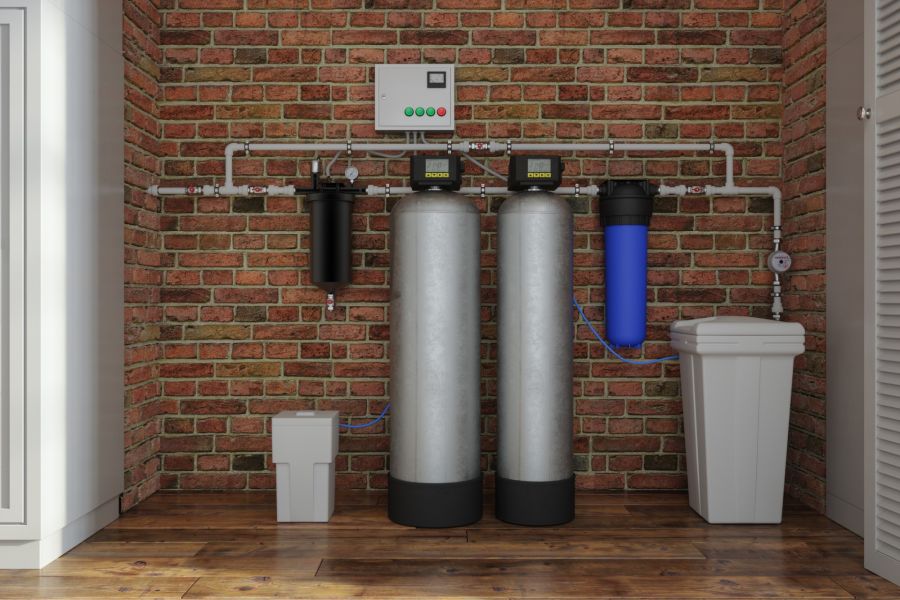
For OC homes, the practical conclusion is that a water treatment system addressing hard water should also address chloramine. A softener alone handles scale but leaves chloramine present. A combo unit that combines a catalytic carbon pre-filter with an ion-exchange softener, or an integrated dual-stage system, handles both issues in a single equipment footprint. This is why combo systems are the most common recommendation for OC homes where the hardness is above 12 gpg and chloramine reduction matters for taste and odor.
Our combo systems in Irvine page covers the Irvine-specific options in detail, and our Irvine water quality guide covers the IRWD softener restriction and what it means for system selection.
What Is the Difference Between a Water Softener and a Water Conditioner?
A water softener and a water conditioner solve the same visible problem, scale, through fundamentally different mechanisms. Understanding the difference matters in OC because Irvine Ranch Water District prohibits standard water softeners, making the distinction a compliance issue for Irvine residents, not just a product choice.
A traditional salt-based water softener uses ion exchange resin. Hard water passes through a tank filled with resin beads that are charged with sodium ions. Calcium and magnesium ions in the water swap places with sodium ions on the resin, leaving softened water downstream. When the resin becomes exhausted, the system flushes it with a salt brine solution that recharges the sodium and flushes the captured calcium and magnesium down the drain. This brine discharge is what IRWD prohibits in Irvine.
A salt-free water conditioner using template-assisted crystallization (TAC) works differently. It does not remove calcium or magnesium from the water. Instead, it converts those minerals into microscopic crystals that remain suspended in the water rather than adhering to surfaces. The minerals are still present in the water chemically but do not bond to pipe walls, heating elements, or fixture surfaces. No brine is produced and no drain connection is required. TAC systems are effective at preventing new scale formation and are IRWD-compliant for Irvine homes.
A third option is a brine exchange service softener, which uses standard ion exchange resin like a conventional softener but does not regenerate on-site. A service company periodically delivers freshly charged tanks and removes the exhausted ones for off-site recharging. Brine exchange service softeners deliver the same soft water result as a conventional softener and are also IRWD-compliant.
The practical difference in water feel is noticeable. Ion-exchange softened water has the characteristic slippery feel on skin that comes from the calcium and magnesium removal. TAC-conditioned water does not have that quality because the minerals remain present. For homeowners who want the full softened-water experience, brine exchange service is the IRWD-compliant path. For homeowners focused primarily on appliance and scale protection, TAC conditioners work well within Irvine hardness levels.
How Do I Know If My Orange County Home Needs a Water Softener?
The clearest indicators of a hard water problem are visible around the home. White or yellowish scale deposits on showerheads, faucet aerators, and the inside rim of kettles are calcium and magnesium precipitation. Spotting on glassware and dishes coming out of the dishwasher is a reliable visual indicator. Soap and shampoo that lathers poorly or requires large amounts to produce a noticeable lather indicates hardness interfering with surfactant chemistry.
Less visible but more financially significant signs include: water heater running longer than expected or heating bills increasing without a change in usage patterns, washing machine drum or water inlet valve scaling over time, and reduced flow from showerheads that were not visibly clogged six to twelve months ago.
A hardness reading above 7 gpg is the objective threshold for hard water classification. Because hardness varies by utility across Orange County, the useful step is to get a reading for your own tap and then decide what grain capacity of softener, if any, that hardness level requires.
To get a precise reading from your actual tap, the fastest option is a free water test in Anaheim Hills if you are in eastern OC, or a free water test in Anaheim for west Anaheim and surrounding OCWD service areas. Our technicians test hardness, TDS, chlorine, and pH on site.
Call (949) 873-1129 to book a free water test. We will work around your schedule.
How Do I Get a Quote for a Water Softener in Orange County?
Every home is different. The right system for your home depends on your grain capacity requirements, water hardness level, plumbing configuration, and whether you need chloramine filtration in addition to softening. Contact us for a free in-home water test and a no-obligation quote.
Here is a summary of the main system types for OC homeowners:
Standard salt-based softener. Sized for your household and local hardness level. Options range from entry-level 32,000 grain units for moderate hardness to high-efficiency demand-initiated units at 64,000 grain for homes at about 17 gpg, such as Anaheim Hills.
Brine exchange service softeners. The IRWD-compliant option for Irvine. Equipment is serviced under a recurring contract, and the service company handles tank exchanges.
Salt-free TAC conditioners. Also permitted in Irvine. A properly sized TAC system provides scale protection at a one-time cost with no consumables.
Whole-house catalytic carbon filter. Addresses chloramine at every fixture. Most OC homeowners who address hardness also address chloramine at the same time via a combo system.
Under-sink reverse osmosis. Drinking water treatment. Many OC homeowners pair a softener or TAC conditioner for whole-house scale protection with an under-sink RO for kitchen drinking and cooking water.
Some OC utilities have periodically offered rebates on high-efficiency demand-initiated softeners. Rebate availability changes regularly, so verify with your specific utility before purchasing. For scheduling and a quote, see our free water testing in Anaheim page.
Get a Free Water Test in Orange County
You cannot size a treatment system accurately without knowing your actual hardness number. Our in-home water test measures hardness in grains per gallon, TDS in parts per million, chloramine level, and pH with calibrated instruments. Results are provided on the spot and explained clearly, with a no-pressure quote for any treatment options that make sense for your home.
We serve all Orange County cities including Anaheim, Anaheim Hills, Irvine, Huntington Beach, Newport Beach, Santa Ana, Fullerton, Garden Grove, Costa Mesa, and Torrance. Call (949) 873-1129 or schedule online at our free water test page.
Ask about financing options when you book your free water test.