Coachella Valley residents depend on groundwater from the Coachella Valley aquifer for virtually all of their drinking water supply. Two public utilities serve most of this 270,000-person region: Coachella Valley Water District, which operates 92 active wells across the eastern and central valley from Desert Hot Springs to the Salton Sea, and Desert Water Agency, which serves Palm Springs and the western valley. Consumer Confidence Reports and official water quality data for 2024 show chromium-6 as the defining issue for both agencies following California's adoption of the nation's first chromium-6 maximum contaminant level at 10 parts per billion in April 2024. CVWD disclosed an average chromium-6 concentration of 9.4 parts per billion across its wells, with individual well readings ranging from zero to 22 parts per billion. Desert Water Agency reports no chromium-6 detections above the new state limit and identifies itself as the only local agency already in compliance. All water delivered by both utilities met all applicable state and federal drinking water standards during the 2024 reporting period.
Schedule a free water test in Riverside County to get a direct reading at your address. Call us at (949) 873-1129.
Where does Coachella Valley drinking water come from?
The Coachella Valley sits in eastern Riverside County between the San Bernardino Mountains to the north and the Santa Rosa Mountains to the south. Unlike the Inland Empire communities to the west, which blend Colorado River water from the Metropolitan Water District with local groundwater, Coachella Valley utilities draw almost entirely from the Coachella Valley aquifer, a deep underground basin recharged by seasonal mountain runoff and managed recharge programs.
CVWD operates more than 92 active wells that draw water from depths of up to 1,300 feet. This deep groundwater has been in contact with the valley's geology for extended periods, which influences its mineral content. The aquifer is recharged through both natural percolation from the Whitewater River and intentional recharge operations that inject imported water to replenish the basin and maintain water pressure.
Desert Water Agency serves Palm Springs, Cathedral City, and portions of Rancho Mirage and Palm Desert in the western portion of the valley. DWA also relies on the same aquifer but blends supplemental imported water supplies and operates its own recharge program.
The isolation from Metropolitan Water District surface deliveries that characterizes the valley means that water quality here is shaped primarily by the local geology and aquifer conditions rather than by the Colorado River or Sierra Nevada source blends that dominate water quality in LA County and the Inland Empire.
How this data was compiled
All utility-level data in this article comes from each utility's Consumer Confidence Report (CCR) and official water quality disclosures. The federal Safe Drinking Water Act requires every public water system serving 25 or more people to publish a CCR annually by July 1, covering the prior calendar year.
CVWD's 2024 data is drawn from its 2024 to 2025 Annual Review and Consumer Confidence Report, available at cvwd.org/Water-Quality and its dedicated chromium-6 information page at cvwd.org/159/Chromium-6.
Desert Water Agency's data comes from its 2024 Water Quality Report, covering monitoring data collected January 1 through December 31, 2024, published in June 2025 and available at dwa.org/reports.
California CCRs are also searchable through the State Water Resources Control Board's Electronic Annual Reporting database at waterboards.ca.gov.
What do 2024 water quality reports show for the Coachella Valley?
The table below summarizes key water quality data from 2024 Consumer Confidence Reports for the two major Coachella Valley utilities.
| Utility | Primary Service Area | Chromium-6 (2024) | Chromium-6 vs CA MCL (10 ppb) | PFAS Detected Above MCL |
|---|
| Coachella Valley Water District (CVWD) | Coachella, Indio, La Quinta, Palm Desert (eastern), Indian Wells, Desert Hot Springs, Thousand Palms | Average 9.4 ppb; range 0 to 22 ppb across active wells | Some wells exceed 10 ppb MCL | Not reported above MCL in 2024 CCR |
| Desert Water Agency (DWA) | Palm Springs, Cathedral City, Rancho Mirage, Palm Desert (western) | Not detected above 10 ppb | In compliance | Not detected above MCL |
Sources: CVWD 2024 to 2025 Annual Review and Consumer Confidence Report (cvwd.org); CVWD Chromium-6 disclosure (cvwd.org/159/Chromium-6); Desert Water Agency 2024 Water Quality Report (dwa.org/reports). All utilities reported full compliance with all state and federal standards during the 2024 reporting period.
What does CVWD's chromium-6 data mean for eastern Coachella Valley residents?
Coachella Valley Water District disclosed that chromium-6 levels across its 92-plus active wells averaged 9.4 parts per billion in 2024, with individual wells showing readings from zero to 22 parts per billion. California's new Maximum Contaminant Level of 10 parts per billion for chromium-6, adopted April 17, 2024 and effective October 1, 2024, is the first enforceable chromium-6 standard in the United States (California Health and Safety Code Section 116365).
The average of 9.4 ppb sits just below the 10 ppb MCL. However, the range of zero to 22 ppb means some CVWD supply wells are producing water that exceeds the new limit before blending and distribution. CVWD is required to notify customers when any contaminant in distributed water exceeds an MCL and sent such notices in late 2025 as it worked through compliance actions.
Chromium-6 occurs naturally in the desert geology of the Coachella Valley, formed through the weathering of chromium-bearing minerals in the mountain formations that border the valley. The Coachella Valley Independent reported in July 2026 that the new chromium-6 standards are expected to require local water agencies to spend more than $525 million collectively on treatment upgrades (Coachella Valley Independent, July 2026).
For CVWD customers in Coachella, Indio, La Quinta, and surrounding communities, the relevant question is whether their tap reading exceeds the 10 ppb threshold. Utility averages reflect the blended distribution water, which differs from individual well readings. A free water test gives you a direct reading.
What does Desert Water Agency's 2024 report show for Palm Springs and the western valley?
Desert Water Agency, which serves Palm Springs, Cathedral City, Rancho Mirage, and portions of Palm Desert, reports a notably different chromium-6 picture. DWA states that it has not detected chromium-6 above the state's new 10 ppb MCL and identifies itself as the only local water agency in the Coachella Valley already in compliance with the new standard.
DWA conducts more than 2,500 water quality tests annually. Its 2024 Water Quality Report covers monitoring data from January through December 2024 and was published in June 2025. DWA reported that 9 contaminants were detected above California's voluntary health-based advisory guidelines during the reporting period, though all were below enforceable Maximum Contaminant Levels. DWA also reported no PFAS detections above state or federal MCLs.
DWA's compliance with the chromium-6 MCL reflects a combination of its specific aquifer zones and its water management practices. The western valley's geology and well depths differ from the eastern valley, contributing to the contrast in chromium-6 levels between the two utilities.
For Palm Springs and Cathedral City residents served by DWA, chromium-6 compliance is confirmed. Other contaminants detected above health advisory guidelines remain worth understanding. A free water test identifies which contaminants are present at your specific tap, providing a more precise picture than utility averages.
What is California's chromium-6 standard and why does it matter?
California adopted an enforceable Maximum Contaminant Level for hexavalent chromium (chromium-6) at 10 parts per billion in April 2024, the first such standard in the United States. Previous federal regulations covered total chromium at 100 ppb but did not set a specific limit for the hexavalent form.
Hexavalent chromium differs from trivalent chromium (chromium-3) in its chemical behavior and health profile. The California Office of Environmental Health Hazard Assessment established a public health goal for chromium-6 at 0.02 parts per billion, based on cancer risk assessments. The enforceable MCL of 10 ppb was set higher than the public health goal because of the cost and technical challenges of treatment at lower concentrations.
For context: the 0.02 ppb public health goal is 500 times more protective than the 10 ppb MCL. Both CVWD and DWA report against the enforceable 10 ppb limit in their CCRs.
Chromium-6 is colorless, odorless, and tasteless at concentrations found in drinking water. Detecting it requires laboratory testing, not sensory evaluation. The standard point-of-use treatment is a reverse osmosis system certified to NSF/ANSI Standard 58, which reduces chromium-6 by 90 percent or more at the drinking tap.
Which water treatment systems address chromium-6 concerns in the Coachella Valley?
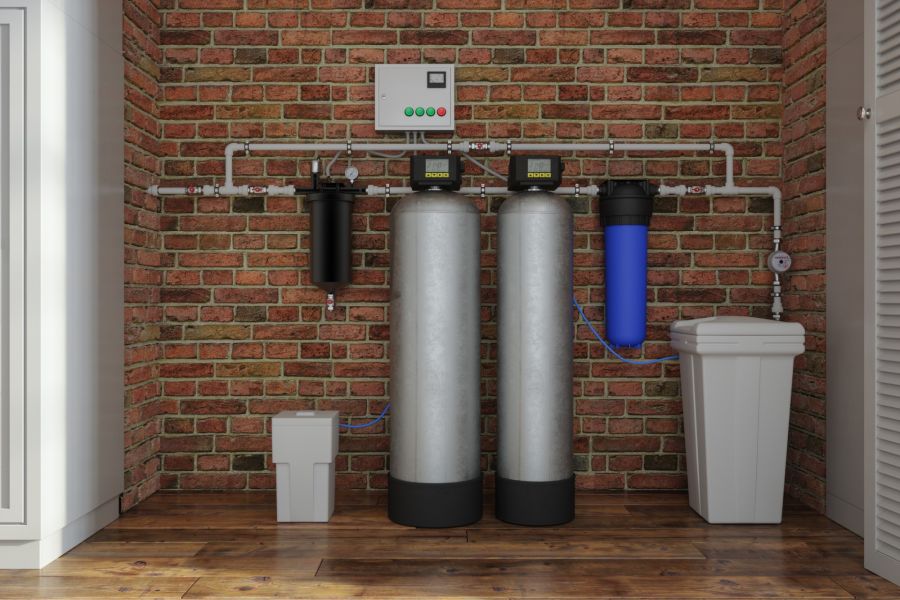
For drinking and cooking water, a reverse osmosis system at the point of use is the most practical and effective treatment for chromium-6. RO systems use a semipermeable membrane to remove dissolved contaminants including chromium-6, arsenic, nitrates, total dissolved solids, and disinfection byproducts. Systems certified to NSF/ANSI Standard 58 have been independently tested and verified to reduce chromium-6 from drinking water.
Standard carbon block filters and whole-house water softeners do not reduce chromium-6 to meaningful levels. A water softener addresses hardness (calcium and magnesium) effectively but has no mechanism for removing chromium-6 or most other dissolved contaminants.
For residents also concerned about water hardness, which is present in Coachella Valley water as calcium and magnesium from the local geology, a combination system pairs a whole-house water softener with a point-of-use RO system: the softener handles scale and appliance wear throughout the home, while the RO unit handles drinking water contaminants at the kitchen tap.
For a broader look at how Coachella Valley water concerns compare to other Riverside County communities, see our analysis of Riverside County water quality by utility. For the San Bernardino County communities to the northwest, see our PFAS data report for the Inland Empire.
To confirm what is actually present at your tap, schedule a free water test in Riverside County. Call (949) 873-1129. We serve communities throughout the Coachella Valley and the broader Riverside County region.