Las Vegas tap water is consistently among the hardest in the United States, with Southern Nevada Water Authority (SNWA) and Las Vegas Valley Water District (LVVWD) annual Consumer Confidence Reports documenting total hardness of 260 to 300 mg/L, the equivalent of 15 to 17 grains per gallon. That reading falls into the very hard category by Water Quality Association standards (wqa.org), where anything above 10.5 gpg causes measurable scale accumulation, reduced soap lathering, and accelerated appliance wear. The source is the Colorado River, delivered to Las Vegas via Lake Mead: the river carries dissolved calcium and magnesium through Rocky Mountain and desert geology, and SNWA does not remove hardness during treatment because it does not pose a primary health risk under EPA drinking water regulations (epa.gov). What remains is a supply that requires in-home treatment, specifically an ion exchange water softener, for households that want to protect water heaters, dishwashers, plumbing, and fixtures from mineral scale.
Schedule a free water test in Las Vegas to get a direct hardness reading at your tap before any equipment decision.
Where Las Vegas water comes from and why hardness matters
The Southern Nevada Water Authority supplies finished drinking water to approximately 2.3 million people in the Las Vegas Valley. According to SNWA's published infrastructure overview (snwa.com), approximately 90 percent of that supply comes from Lake Mead, the reservoir on the Colorado River formed by Hoover Dam. The remaining portion comes from a smaller groundwater program.
The Colorado River is one of the most mineralized major river systems in North America. Its headwaters draw from calcium-rich formations in the Rocky Mountains, and the river collects additional dissolved solids as it flows through limestone and dolomite geology across multiple western states. By the time Colorado River water reaches Lake Mead, it carries a substantial dissolved mineral load before any additional concentration from desert evaporation.
Lake Mead itself contributes to the mineral concentration problem. The reservoir spans roughly 248 square miles of surface area, and in the extreme heat of a Nevada summer, surface evaporation removes water molecules while dissolved minerals stay behind. This is the same mechanism documented by the Bureau of Reclamation's Colorado River salinity monitoring program (usbr.gov/lc/region/g4000/salinity), which tracks mineral concentration trends across the river system.
SNWA's two water treatment facilities process Lake Mead water to meet all EPA primary drinking water standards. That process removes turbidity, treats for biological contamination, and controls disinfection byproducts. Hardness is a secondary standard under EPA regulations, meaning there is no enforceable maximum contaminant level, and SNWA does not remove it. Calcium and magnesium pass through treatment and arrive at the tap.
What SNWA hardness data shows year over year
LVVWD publishes an annual Consumer Confidence Report (CCR) by July 1 each year, covering the prior calendar year, as required by the Safe Drinking Water Act. The report is available at lvvwd.com and at the Nevada Division of Environmental Protection database.
CCR data for the Las Vegas Valley distribution system over multiple recent reporting periods shows total hardness in the range of 260 to 300 mg/L. In grains per gallon, that converts to approximately 15.2 to 17.5 gpg. For reference:
| Hardness Category | Range (gpg) | Las Vegas position |
|---|
| Soft | 0 to 3.5 gpg | Well above |
| Slightly hard | 3.5 to 7 gpg | Well above |
| Moderately hard | 7 to 10.5 gpg | Above |
| Hard | 10.5 to 14 gpg | Above |
| Very hard | 14+ gpg | In range |
Classification source: Water Quality Association consumer water hardness guide (wqa.org).
At 15 to 17 gpg, Las Vegas is definitively in the very hard category. By comparison, the national average for municipal water hardness is approximately 13 gpg according to the USGS Water Science School (usgs.gov/special-topics/water-science-school). Las Vegas runs materially harder than that average.
The hardness also varies somewhat by season. Summer heat accelerates evaporation from Lake Mead's surface, concentrating dissolved solids in the reservoir. SNWA's treatment plant intake draws from Lake Mead at a depth where temperatures are more stable, but the reservoir-wide concentration effect is real and documented. Hardness readings at the tap may be slightly higher in late summer than in spring, as discussed in why Phoenix and Las Vegas tap water tastes saltier in summer.
How Las Vegas hardness affects homes specifically
At 15 to 17 gpg, the effects of hard water are not gradual or theoretical. They are visible within months of moving into an untreated home.
Water heater scale. Scale deposits inside a tank water heater from very hard water reduce heat transfer efficiency and can coat the heating element. The Water Quality Research Foundation commissioned Battelle Memorial Institute to study this effect; that research found measurable efficiency loss from scale in hard water areas. In Las Vegas, the high incoming hardness accelerates the timeline. A water heater running on unsoftened Las Vegas tap water accumulates scale faster than the same unit in a moderately hard water region.
Dishwasher film and spotting. Las Vegas homeowners on city water without a softener frequently report white film on glassware and dishes even with quality detergent. The film is calcium carbonate, the same material in limescale, precipitating out of hot rinse water during the drying cycle. The American Cleaning Institute (cleaninginstitute.org) publishes data on detergent performance in hard versus soft water: very hard water significantly reduces the effectiveness of standard dishwasher detergents.
Showerhead and faucet scaling. Mineral deposits block showerhead nozzles and aerator screens at a rate proportional to water hardness. In very hard water above 14 gpg, aerators may need cleaning or replacement within a year. Showerheads show visible scale on the spray plate within months.
Soap and shampoo. Hard water minerals react with soap compounds to form insoluble soap scum rather than lather. People on unsoftened Las Vegas water frequently use more shampoo and body wash than they did in a softer water region, and still notice a flat, non-rinsing feel.
Plumbing. Long-term scale accumulation inside pipes, particularly in copper plumbing, reduces flow rates over years. This is a slower effect than appliance scale, but it is cumulative.
What an ion exchange water softener does in Las Vegas conditions
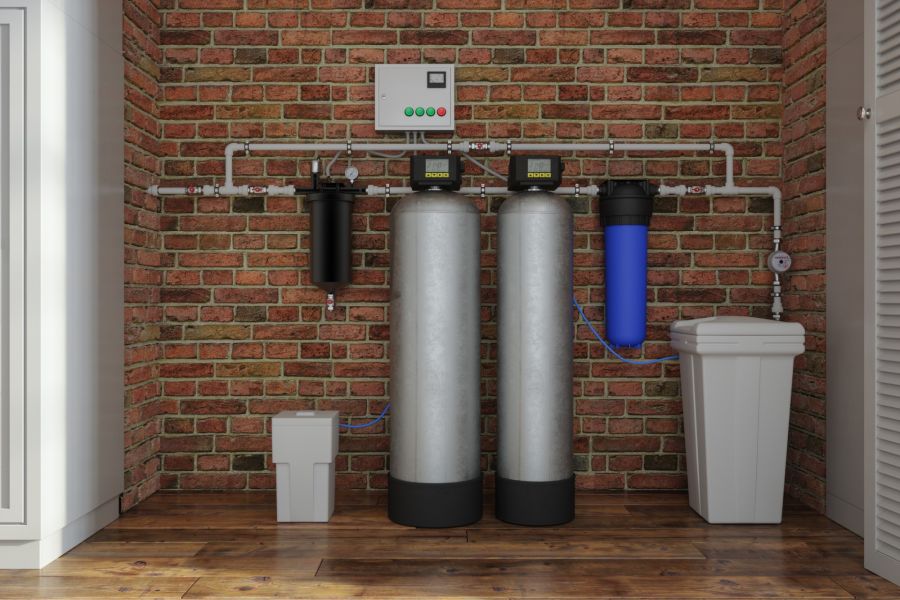
An ion exchange water softener is the only residential technology that removes hardness minerals from the water supply throughout the entire home. Other technologies (salt-free conditioners, electromagnetic devices, template-assisted crystallization) alter how minerals behave but do not remove them from the water. An ion exchange unit physically extracts calcium and magnesium through a charged resin bed and replaces them with sodium or potassium ions.
The process is straightforward. Hard water enters the softener tank and passes through a bed of negatively charged resin beads that have been loaded with sodium (or potassium) ions. Calcium and magnesium carry a positive charge and are attracted to the resin, swapping places with the sodium. The water leaving the softener is soft. Periodically, the resin is regenerated by flushing with a brine solution that reloads the beads with sodium and flushes the accumulated calcium and magnesium down the drain.
For Las Vegas conditions specifically:
Sizing. At 17 gpg incoming hardness, a four-person household using 80 gallons per person per day produces a daily hardness load of approximately 5,440 grains (4 people x 80 gpd x 17 gpg). A 45,000-grain softener at that load regenerates roughly every 8 days. Most Las Vegas single-family homes need 40,000 to 80,000 grain capacity depending on household size and usage patterns. A direct water test at your tap confirms the exact incoming gpg before sizing.
Salt type. Las Vegas's chloramine-treated water has no specific interaction with salt selection, but Las Vegas water's high TDS means mineral accumulation in the brine tank can vary with salt purity. High-purity sodium chloride pellets (evaporated salt) or potassium chloride minimize bridging and mushing in the brine tank more reliably than rock salt in hot, dusty Nevada conditions.
Regeneration frequency. Demand-initiated regeneration (DIR) softeners regenerate based on actual water use rather than a fixed schedule. In Las Vegas, where seasonal usage varies substantially between winter and summer, a DIR unit avoids both over-regeneration (wasting salt in winter) and under-regeneration (failing to soften in high-demand summer).
See water softeners in Las Vegas for details, and water softeners vs combo systems for a comparison if you are also dealing with chloramine taste.
Chloramine: the second issue that softeners do not solve
SNWA switched the Las Vegas Valley distribution system from free chlorine to monochloramine disinfection in 2003. Monochloramine is a more stable disinfectant than free chlorine, which reduces disinfection byproduct formation in the distribution system. SNWA documents this in its Consumer Confidence Report and Water Quality Report (snwa.com).
The trade-off is taste. Monochloramine has a distinct taste that many Las Vegas residents describe as a flat, slightly chemical character in tap water. Standard granular activated carbon (GAC) filtration does not effectively break the chloramine bond. Addressing chloramine taste requires catalytic carbon, which has a higher surface activation than standard GAC and can cleave the chlorine-ammonia bond that standard carbon cannot.
A softener does not address chloramine at all. If chloramine taste is your primary concern, you need a catalytic carbon whole-house filter, an under-sink reverse osmosis unit, or a combination of both. If both hardness and chloramine taste are present, a combination softener-plus-catalytic-carbon system is the most complete solution, detailed at combo systems in Las Vegas.
An under-sink reverse osmosis system in Las Vegas addresses drinking water taste most effectively. A properly maintained NSF/ANSI 58-certified RO membrane reduces TDS by 90 to 98 percent and removes chloramine compounds from drinking water.
Henderson and North Las Vegas: same SNWA supply, same hardness
Henderson Water Utility and the City of Henderson serve homes in the Henderson and Green Valley areas. Both utilities draw from the same SNWA finished water supply. Henderson Water Utility publishes its own annual Consumer Confidence Report, available at hendersonwa.gov/public-services/utilities, which shows hardness in the same 260 to 300 mg/L range as LVVWD data.
North Las Vegas is also served by SNWA, with the same hardness profile.
This means the softener sizing guidance above applies across the Las Vegas Valley. There is no meaningful hardness difference between a home in Summerlin, Henderson, North Las Vegas, or central Las Vegas on city water. All are on the same Colorado River source water with the same hardness characteristics.
For Henderson-specific service, see water softeners in Henderson and free water testing in Henderson.
The case for a free water test before buying
SNWA and LVVWD publish system-wide hardness averages, not address-specific readings. Several factors can cause your tap reading to differ from the published average:
Your plumbing material. Copper and PEX plumbing do not add minerals to your water, but older galvanized steel can introduce iron and sediment. Iron changes your softener sizing and may require a separate iron filter upstream of the softener.
Your distribution zone. LVVWD blends supplies across different distribution zones. Homes farther from major transmission mains may see slightly different readings than the system average.
Private well. A small number of Las Vegas Valley homes on acreage parcels use private wells rather than city water. Well water in the Las Vegas area can have very different mineral profiles from SNWA treated water, and requires independent testing.
A direct in-home water test gives you the actual hardness in gpg at your tap, confirms whether iron is present, checks TDS, and identifies whether chloramine is at a level you can taste. That reading is the correct input for sizing a softener, not the LVVWD system average.
Schedule a free water test in Las Vegas before any softener purchase. Call (949) 873-1129 any time. See signs you need a water softener if you are still diagnosing whether hardness is your primary water issue.
What to do next
If you are on Las Vegas Valley city water and have not treated for hardness, the data is consistent: your incoming hardness is in the very hard range, and scale accumulation is happening in your plumbing, water heater, and appliances whether visible or not.
The standard path for Las Vegas homeowners:
- Free water test. Confirm your gpg and check for iron, TDS, and chloramine levels.
- Size the softener. Match grain capacity to household size and confirmed incoming hardness.
- Decide on secondary treatment. If chloramine taste is a concern, add a catalytic carbon stage or an under-sink RO unit. If drinking water quality is the priority, an under-sink RO in Las Vegas is the most effective single fix for taste and TDS.
For Las Vegas homes with hard water also showing signs of scale in the water heater, see water heaters in Las Vegas for how scale affects heater lifespan and what to do about it.
Review the Las Vegas whole-house water filtration guide if you are considering a whole-house carbon filter alongside the softener. For a full picture of Las Vegas water quality context, Phoenix water quality covers the same Colorado River source water from a regional perspective.
Get a free water test in Las Vegas or call (949) 873-1129 to talk through the right configuration for your home.
Sources used in this article:
- Southern Nevada Water Authority annual Water Quality Report and Consumer Confidence Report: snwa.com
- Las Vegas Valley Water District Consumer Confidence Reports: lvvwd.com
- Henderson Water Utility Consumer Confidence Reports: hendersonwa.gov
- Water Quality Association hardness classification guide: wqa.org
- U.S. Bureau of Reclamation Colorado River salinity monitoring program: usbr.gov/lc/region/g4000/salinity
- U.S. EPA secondary maximum contaminant levels: epa.gov/your-drinking-water
- NSF/ANSI 44 (water softeners) and NSF/ANSI 58 (reverse osmosis) certification standards: nsf.org
- U.S. Geological Survey water hardness information: usgs.gov/special-topics/water-science-school
- American Cleaning Institute hard water and detergent performance data: cleaninginstitute.org