By Purest Water Solutions Team | Last Updated: July 28, 2026
Commercial kitchens, restaurants, ice machine operations, and office buildings in Chandler and Gilbert, Arizona face a specific water quality challenge: source water that averages 16.5 grains per gallon of hardness, according to the City of Chandler Water Quality FAQ at chandleraz.gov, and total dissolved solids that regularly exceed 700 mg/L in the East Valley. That mineral load corrodes commercial ice machines within 18 to 24 months, ruins espresso equipment calibration, and forces businesses to spend more on descaling chemicals and equipment replacement than the water treatment system that would have prevented those costs. A commercial reverse osmosis system removes 92 to 99 percent of dissolved solids at the point of use, delivering water that consistently meets NSF/ANSI 58 purity standards. This guide covers how to select and size a commercial RO unit for a Chandler or Gilbert business, what the local water profile means for your equipment, and how to maintain the system to protect your investment long term.
Get a free commercial water test in Chandler or Gilbert. Book online or call (949) 873-1129. No obligation, no sales pressure.
Why does Chandler water damage commercial equipment faster?
Chandler's water supply comes from three sources: a surface water treatment plant that handles about 60 percent of daily demand, the Santan Vista Water Treatment Plant shared with Gilbert at about 20 percent, and 32 groundwater wells covering the remaining supply, according to the City of Chandler Water Quality FAQ. All three sources carry high mineral loads typical of the Colorado River watershed and Arizona's calcium-rich geology.
The result is a water hardness range of 5 to 20 grains per gallon city-wide, with a published average of 16.5 gpg. At 16.5 gpg, calcium carbonate deposits form on heat-transfer surfaces inside water heaters, boilers, and steam-inject ovens quickly enough to reduce thermal efficiency measurably within one to two years of operation. Scale acts as an insulator: a layer as thin as 1/8 inch on a heat exchanger can reduce heating efficiency by 25 percent, driving up gas or electricity costs before any equipment failure is visible (U.S. Department of Energy, Office of Energy Efficiency, Tip Sheet #70).
Commercial ice machines are especially sensitive. Scale on evaporator plates changes the contact angle of water during the freeze cycle, producing smaller, cloudy cubes and forcing longer freeze cycles. Most commercial ice machine warranties specifically exclude mineral scale damage, so Chandler businesses absorb replacement costs out of pocket.
An RO system in Chandler removes the dissolved calcium and magnesium before water enters the equipment feed line, eliminating the source of scale rather than treating its symptoms.
What contaminants are in Chandler and Gilbert commercial water?
Beyond hardness, East Valley commercial operators should be aware of three additional water quality factors that affect food service, beverage programs, and equipment performance.
Total dissolved solids (TDS). Chandler's surface water sources blend Colorado River water and Salt River Project supply, both of which carry high TDS from hundreds of miles of mineral-rich terrain. Neighboring Gilbert's published average TDS is approximately 795 mg/L with peaks reaching 942 mg/L according to the Town of Gilbert's 2024 Consumer Confidence Report. Chandler's TDS profile is similar given shared source water through the Santan Vista plant. TDS above 500 mg/L produces off-flavors in filtered coffee and fountain beverages, causes scaling on espresso group heads within weeks, and reduces ice clarity in commercial cube makers.
Disinfectant residual. The City of Chandler 2025 Drinking Water Quality Consumer Confidence Report lists chlorine as the disinfectant it measures in the distribution system and says groundwater is disinfected with chlorine (City of Chandler 2025 Consumer Confidence Report). We could not verify that any part of the system uses chloramine, so check the current report for your water source. Carbon pre-filtration protects thin-film composite membranes from the disinfectant residual, and chloramine, where a utility uses it, needs catalytic carbon rather than standard carbon. Specify pre-filtration rated for the disinfectant in your water.
Arsenic and PFAS. Groundwater in Maricopa County contains naturally occurring arsenic. The EPA maximum contaminant level for arsenic is 10 ppb. Municipal treatment generally keeps arsenic at or near the MCL, but point-of-use RO provides an additional reduction layer. PFAS compounds have been detected in East Valley groundwater sources at low levels (EPA PFAS monitoring database). An NSF/ANSI 58 certified RO system with appropriate membranes reduces both arsenic and PFAS at the tap.
Read our Chandler water quality guide for a detailed breakdown of what Chandler residential and commercial water tests show year-round. Gilbert businesses with similar water quality challenges should also see water softeners in Gilbert and whole-house water filtration in Chandler.
What types of commercial RO systems are available for Chandler businesses?
Commercial RO systems scale from compact under-counter units to large-capacity skid-mounted systems, and the right type depends on daily water demand and application.
Point-of-use commercial RO units (100 to 500 GPD). These connect directly to a coffee machine, ice maker, or single-source beverage line. They include a membrane, sediment pre-filter, carbon pre-filter, and a storage tank sized for the equipment's peak demand. Restaurants with one or two piece of sensitive beverage equipment typically use this configuration. The small footprint fits inside a standard equipment cabinet.
Rack-mounted commercial RO systems (500 to 2,000 GPD). Mid-size foodservice operations such as full-service restaurants, hotel kitchens, and large office buildings use rack-mounted systems that treat water for multiple endpoints simultaneously: ice machine, coffee station, steam equipment, and a dedicated potable-water tap. These systems usually include a booster pump to maintain feed pressure, multiple membrane elements, and a larger atmospheric storage tank with a repressurization pump.
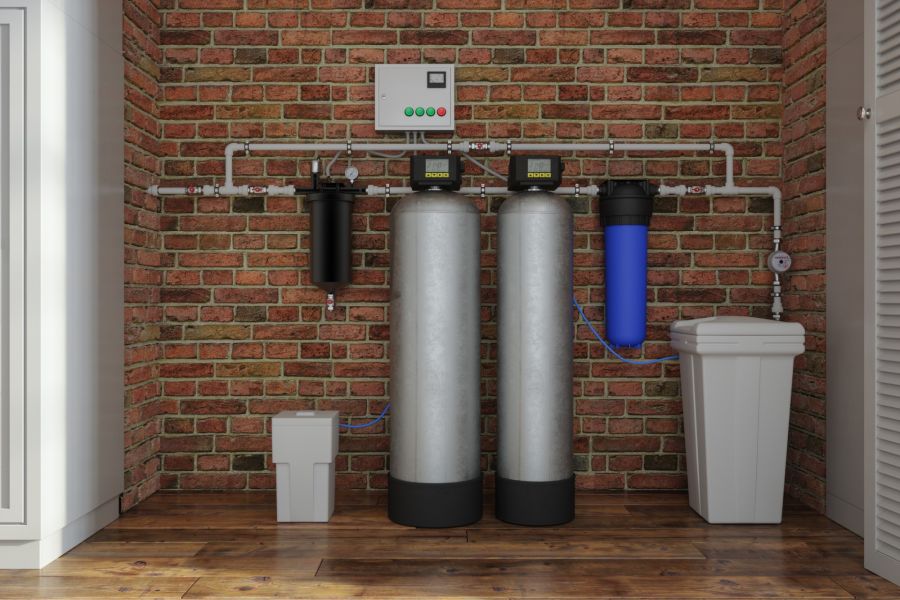
High-capacity commercial RO systems (2,000 to 10,000+ GPD). Breweries, car washes, medical facilities, and large-scale foodservice operations in the Chandler area use high-capacity systems with multiple membrane banks, automated flush cycles, real-time TDS monitoring, and remote access panels. These systems require a dedicated mechanical space and typically need a commercial water softener in Chandler as a pre-treatment stage to protect the membranes from rapid fouling in Chandler's 16.5 gpg water.
Our best commercial RO systems for businesses page compares configurations and capacity ranges for East Valley business types.
Which East Valley businesses need commercial RO systems?
Any Chandler or Gilbert business where water quality directly affects product quality or equipment longevity is a candidate for commercial RO. The most common applications are:
Full-service restaurants and quick-service operators. Chandler's high TDS affects the taste of ice water, fountain beverages, soup stocks, and pasta cooking water. Many national QSR franchise agreements now require RO at ice and beverage stations to maintain product consistency across locations. An on-site commercial RO system ensures the same standard of water quality regardless of how Chandler's municipal blend shifts seasonally.
Coffee shops and specialty beverage operations. Specialty coffee extraction quality is directly tied to water mineral content. The Specialty Coffee Association recommends a target TDS of 150 mg/L and total hardness of 17 to 85 mg/L for optimal espresso extraction. Chandler water at 700 to 800 mg/L TDS is more than four times the upper end of that recommendation, producing under-extracted, bitter shots and rapid scale buildup on group heads and steam wands (Specialty Coffee Association Water Quality Handbook, sca.coffee).
Hotels and hospitality operations. Ice machines at hotel properties in Chandler run continuously under high demand conditions. Scale buildup on evaporator plates forces extended freeze cycles, adds 15 to 20 percent to ice machine energy use, and shortens compressor life. A dedicated ice machine RO system is the most cost-effective protection for a hotel's ice-making fleet.
Healthcare and dental offices. Arizona State Board of Dental Examiners guidelines require dental waterlines to deliver water meeting a colony-forming unit count below 500 CFU/mL. RO is the standard pre-treatment for dental unit waterline compliance in high-TDS markets like Chandler and Gilbert.
Office buildings and corporate campuses. Building-wide RO combined with a post-filter remineralization cartridge delivers consistent drinking water quality for employees and eliminates the cost and plastic waste of bottled-water delivery.
For a broader look at how an RO system compares to other water treatment options for East Valley businesses, see our RO versus combo systems comparison page.
Schedule a commercial water assessment for your Gilbert or Chandler business. Request your free water test or call (949) 873-1129 to talk through your application.
How is a commercial RO system sized for a Chandler restaurant or ice machine?
Sizing a commercial RO system requires four inputs: daily water demand in gallons, feed water TDS, feed water temperature, and line pressure available at the connection point.
Calculate daily demand. For a commercial ice machine, check the manufacturer's specification sheet for daily water consumption per 100 pounds of ice produced. A 500-pound-per-day cube ice machine typically consumes 500 to 700 gallons of water per 24-hour period (including reject water). For a coffee operation, count the number of espresso machines, batch brewers, and steam pitchers running per day and total their hourly consumption rates.
Account for RO recovery rate. Commercial RO systems do not convert all incoming water to purified water. Recovery rates typically run 50 to 75 percent at Chandler feed pressures and temperatures. A system rated at 500 gallons per day of purified output will require 700 to 1,000 gallons per day of feed water.
Adjust for Chandler TDS. Membrane flux rate decreases as TDS and temperature change. Chandler's source water at approximately 700 to 800 mg/L TDS and summer temperatures above 90 degrees Fahrenheit at the feed line can reduce membrane output by 10 to 15 percent compared to manufacturer ratings, which are typically stated at 77 degrees Fahrenheit and 500 mg/L TDS. A properly specified system is oversized by 15 to 20 percent to maintain adequate output during Chandler's peak summer conditions.
Size the storage tank. A storage tank buffer prevents the booster pump from short-cycling and ensures adequate supply during peak demand. Most commercial applications use a storage tank sized to hold 30 to 60 minutes of peak-demand consumption. A free water test in Chandler gives you the actual TDS and hardness readings needed to finalize sizing without guessing.
What maintenance does a commercial RO system require?
A commercial RO system in Chandler's water environment needs more frequent attention than the same system in a lower-TDS market. A proactive maintenance schedule keeps the system producing at rated output and extends membrane life.
Monthly checks. Read the inline TDS meter on the permeate (purified) outlet and compare it to the feed TDS. If rejection rate drops below 90 percent, a membrane or pre-filter is failing. Check pre-filter housings for discoloration or odor, which signals a carbon media change is overdue. Verify booster pump pressure is within the manufacturer's operating range.
Every 3 to 6 months: Pre-filter replacement. In Chandler's water, sediment pre-filters often load within 90 days at higher-flow commercial sites. Carbon pre-filters should be replaced on the low end of the schedule to prevent disinfectant breakthrough to the membrane.
Every 12 to 24 months: Membrane inspection. Pull and inspect membranes for scaling, biofouling, or mechanical damage. Chandler water's high calcium load means membranes at sites without a softener pre-stage typically need replacement at 12 to 18 months. Sites with a properly maintained water softener ahead of the RO membrane can extend membrane service to 24 months.
Annually: Full system sanitization. Bacteria can colonize storage tanks and distribution tubing in systems that sit idle overnight or during seasonal shutdowns. A full sanitation flush with NSF-approved sanitizer removes biofilm and keeps downstream equipment in compliance with health code requirements.
Our team provides commercial service contracts for Chandler and Gilbert businesses that cover pre-filter replacement, membrane testing, and annual sanitization on a fixed schedule.
Contact us to discuss RO systems in Chandler or RO systems in Gilbert for scheduling and site assessment timelines specific to your business.
Ready to protect your commercial equipment from Chandler's hard water? Our team serves restaurants, hotels, healthcare facilities, and office buildings across the East Valley. Book a free commercial water test today or call (949) 873-1129. We will work around your schedule.
For PFAS concerns in East Valley water, see our PFAS water filter guide. For a broader comparison of treatment options, visit our reverse osmosis vs combo systems comparison.
Related pages