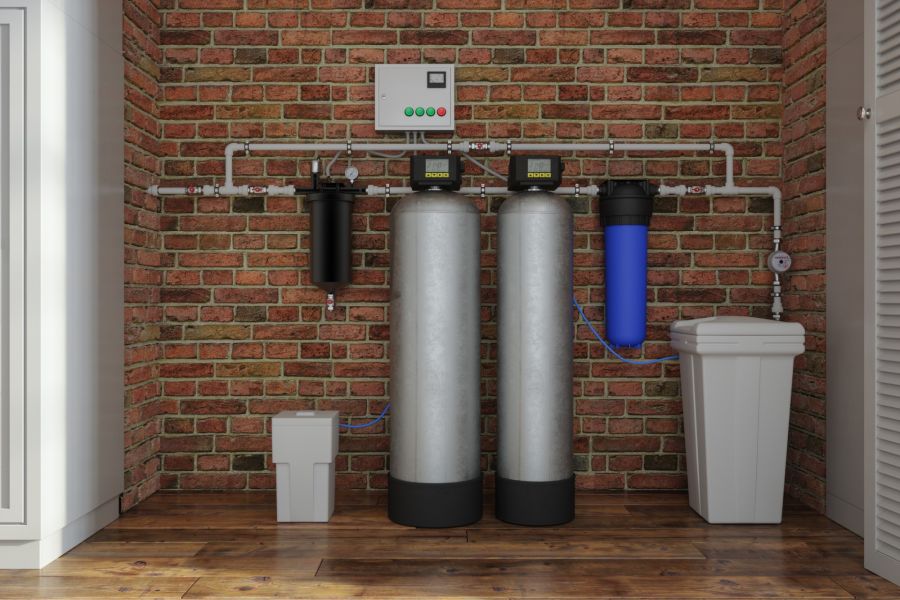
Rancho Cucamonga tap water presents three distinct water quality factors that homeowners frequently ask about: high hardness, elevated total dissolved solids (TDS), and chromium-6 detections in the groundwater supply that feeds the local system. Consumer Confidence Reports from Cucamonga Valley Water District (CVWD) published between 2021 and 2024 show total hardness ranging from 280 to 340 mg/L, or 16 to 20 grains per gallon, placing Rancho Cucamonga in the very hard category by Water Quality Association standards. Colorado River water delivered by the Metropolitan Water District, which makes up a substantial portion of CVWD's supply, enters Southern California already carrying TDS in the 500 to 700 mg/L range per Bureau of Reclamation monitoring (usbr.gov). And the Chino Basin, one of CVWD's groundwater sources, has documented chromium-6 detections relevant to California's 2024 Maximum Contaminant Level of 10 parts per billion (Health and Safety Code Section 116365). These three issues require different treatment approaches, and understanding which is present at your tap starts with knowing the data.
Schedule a free water test in Rancho Cucamonga to get a direct reading at your address. Call (949) 873-1129 any time.
Where Rancho Cucamonga's water comes from
CVWD draws from three primary sources and blends them based on seasonal availability and groundwater basin conditions.
The first source is Metropolitan Water District of Southern California (MWD) imported water, delivered via the Colorado River Aqueduct and Inland Feeder. This treated surface water is CVWD's largest supply component in most years. Colorado River water is well-known for high mineral content accumulated during its course through the desert Southwest. The Bureau of Reclamation's Colorado River Lower Basin salinity monitoring program (available at usbr.gov/lc/region/g4000/salinity) documents long-term TDS trends in delivered water.
The second source is the Cucamonga Basin, a local groundwater basin shared with adjacent agencies. The Cucamonga Basin Watermaster publishes annual basin reports documenting water levels and quality trends, available at cucamongabasin.com. Groundwater from this basin tends to carry higher mineral concentrations from the region's geology.
The third source is the Chino Basin, managed by the Chino Basin Watermaster (cbwm.org). The Chino Basin has a documented history of nitrate contamination from agricultural and dairy operations, as well as chromium-6 detections tied to natural geological sources and historical industrial activity in the region. The California Regional Water Quality Control Board, Santa Ana Region, has tracked Chino Basin water quality for decades and maintains public records at swrcb.ca.gov.
The blend ratio among these three sources shifts seasonally and year to year, which is why hardness and TDS readings can vary between reporting periods and between distribution zones within the CVWD service area.
How we compiled this data
The hardness range in this article (280 to 340 mg/L, 16 to 20 gpg) comes from CVWD Consumer Confidence Reports for reporting years 2021 through 2024. CCRs are annual reports that California utilities must file with the State Water Resources Control Board by July 1 each year. They are publicly available at cvwd.com and at the SWRCB Electronic Annual Reporting database at waterboards.ca.gov.
TDS data for Colorado River source water comes from Bureau of Reclamation salinity monitoring reports, which are publicly available at usbr.gov. These represent source water at the point of delivery, before distribution system blending and treatment. Finished water TDS in CVWD's distribution system will differ from source water TDS.
Chromium-6 context comes from California Health and Safety Code Section 116365 (the 2024 MCL adoption), OEHHA's risk assessment for hexavalent chromium (available at oehha.ca.gov), and the California State Water Board's enforcement framework for the new standard. For utility-specific detection data, the EWG Tap Water Database at ewg.org/tapwater compiles CCR-reported detection levels alongside health guideline comparisons.
The hardness problem: scale, soap, and appliances
At 16 to 20 grains per gallon, Rancho Cucamonga's water sits in the upper range of hard water nationally. The practical effects are visible throughout the home.
Scale deposits form inside water heaters, dishwashers, faucet aerators, and showerheads. At hardness levels above 15 gpg, scale buildup inside a tank water heater is measurable within the first year of use and reduces thermal efficiency over time. The Water Quality Research Foundation commissioned Battelle Memorial Institute to quantify this effect; the research confirmed that hard water scale accelerates the need for flushing, maintenance, and eventual equipment replacement.
Soap performance degrades with hardness. Calcium and magnesium react with soap and detergent to form insoluble soap scum rather than lather. The American Cleaning Institute (cleaninginstitute.org) has published consumer testing data showing that households with very hard water (above 15 gpg) use substantially more laundry detergent and dishwasher products than households with softened water.
Ion exchange water softeners are the only treatment method that removes calcium and magnesium from the supply. The resin bed swaps sodium or potassium ions for hardness minerals, producing soft water at every fixture and appliance throughout the home.
The TDS factor: Colorado River source water
Total dissolved solids is a measure of all dissolved minerals, salts, and metals in water. Colorado River water, which MWD delivers to CVWD and other Southern California agencies, carries TDS reflecting its passage through mineral-rich geology in multiple western states.
High TDS affects taste at the drinking tap and can affect appliances and fixtures over time, though the effects are less dramatic than hardness at similar concentration levels.
The treatment option most effective against TDS at the drinking tap is reverse osmosis. An NSF/ANSI 58-certified RO membrane reduces TDS by 90 to 98 percent in typical residential use, producing water well below 50 mg/L at the kitchen faucet. RO systems are point-of-use devices, meaning they treat water at a single tap rather than throughout the house.
For whole-house TDS reduction, no practical residential option exists; whole-house treatment is disproportionately expensive for TDS reduction alone. The standard approach is a softener for whole-house hardness and an under-sink RO unit for drinking water.
Chromium-6: the 2024 California MCL
Chromium-6 (hexavalent chromium) is a naturally occurring and industrially released contaminant. California's Office of Environmental Health Hazard Assessment (OEHHA) determined that chromium-6 is a probable human carcinogen at elevated exposure levels and established a public health goal of 0.02 parts per billion (ppb) in 2011.
California adopted a Maximum Contaminant Level of 10 ppb for chromium-6 under Health and Safety Code Section 116365, with a compliance date phased in starting 2024. This is distinct from the federal total chromium MCL of 100 ppb, which covers both chromium-6 and chromium-3.
Groundwater in parts of the Inland Empire, including areas fed by the Chino Basin, has documented chromium-6 detections. CVWD blends multiple sources, so the relevance to any specific address depends on which supply zones serve that distribution area. CVWD's Consumer Confidence Report specifies detected levels by reporting period.
For homeowners concerned about chromium-6 in drinking water, a point-of-use reverse osmosis system certified to NSF/ANSI Standard 58 for chromium-6 reduction is the practical treatment option. The EPA's water treatment guide (epa.gov/your-drinking-water) confirms that RO membranes reduce hexavalent chromium from drinking water when the system carries NSF/ANSI 58 certification.
What these three factors mean at home
The combination of high hardness, elevated TDS, and potential chromium-6 exposure adds up to a case for layered treatment: a softener for whole-house hardness protection and an RO unit for drinking water quality.
A softener does not address chromium-6 or TDS at the drinking tap. An RO unit does not address the whole-house scale and soap efficiency problems caused by hardness. Together, they cover the full picture that Rancho Cucamonga's water presents.
The starting point before any equipment decision is a water test at your specific address. Utility averages represent a distribution zone, not every tap. A direct test confirms what you are actually receiving, which may vary by a few gpg from the CVWD average depending on your street and distribution main.
See water softeners in Rancho Cucamonga and whole house water filtration in the Inland Empire for full treatment options available in the area.
Call (949) 873-1129 or schedule a free water test in Rancho Cucamonga for a direct reading at your address.