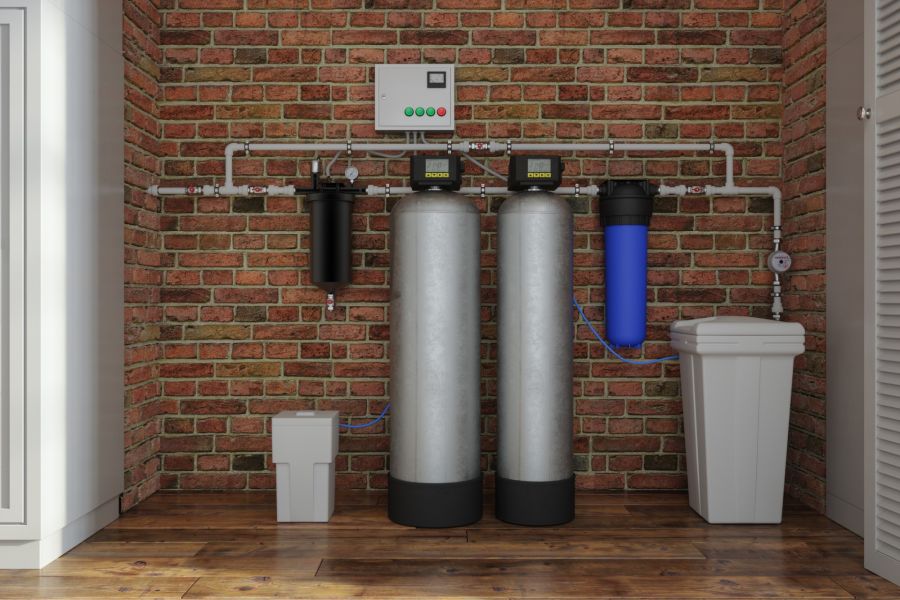
If you live in Los Angeles and your dishes keep spotting, your shower door is chalky, or your water heater is throwing scale, the cause is almost certainly the same: LA tap water is hard, and how hard depends entirely on your zip code. Westside homes typically read 8 to 12 grains per gallon. Valley homes read 15 to 20. East LA sits in the middle at 13 to 16. This guide explains why, how to find your number, and what to do about it.
What "Hard Water" Means in Los Angeles
Hard water is water carrying dissolved calcium and magnesium minerals, measured in grains per gallon (gpg) or milligrams per liter (mg/L) of calcium carbonate equivalent. The Water Quality Association defines anything over 7 gpg as "hard" and anything over 10.5 gpg as "very hard." Los Angeles tap water averages 12 to 17 gpg system-wide, which puts the entire city solidly in the very-hard range.
The reason LA hardness varies so much by neighborhood is that LADWP does not have one source. The Department of Water and Power blends three supplies: Los Angeles Aqueduct water from the Owens Valley and Mono Basin (soft), Metropolitan Water District treated imports from the Colorado River and State Water Project (hard to very hard), and local groundwater from the San Fernando, Sylmar, and Central basins (variable). Each LADWP service zone gets a different ratio, and the ratio changes year to year. For a full primer on what is in LA water beyond hardness, see our hard water signs overview.
Quick Diagnostic: Is Your Block Hard?
Before you spend money on equipment, run these four checks. Each takes under five minutes.
1. Soap-and-jar test. Half-fill a clear jar from the cold tap, add 10 drops of pure liquid Castile soap, cap it, and shake hard for 10 seconds. Soft water (under 7 gpg) produces a thick column of suds that holds for 30 seconds. Hard water produces thin foam that collapses fast, and the water turns slightly cloudy. Very hard water leaves a visible curd ring on the glass.
2. Hardness test strip. A box of 50 hardness strips is available at any hardware store. Dip one in cold tap water for one second, wait 15 seconds, and read the color against the chart. Strips give you a gpg number within about two grains, which is accurate enough to decide whether you need treatment.
3. Dishwasher spot check. Run a normal cycle with no detergent, just water. Open the dishwasher and look at a clear glass on the top rack. Soft water leaves it clear. Hard water leaves a white film and visible water spots within one cycle. Very hard water leaves a chalky coating you can feel with a finger.
4. Shower-door look. Walk to the shower and examine the glass door an hour after last use. A clean door with maybe one or two water streaks means under 10 gpg. A door with a uniform haze and white mineral spots across the entire surface means 12 to 18 gpg. A door that looks etched even after squeegeeing means well over 18 gpg and you have a daily fight on your hands.
Westside Zips: 902xx, 904xx, 90049, 90272
Westside Los Angeles (Brentwood, Pacific Palisades, Beverly Hills-adjacent, Mar Vista, Venice, Santa Monica-adjacent LADWP service areas) pulls the largest share of Los Angeles Aqueduct water. The Aqueduct delivers Eastern Sierra snowmelt that has not picked up much mineral load on its way down. Westside cold-tap hardness reads 8 to 12 gpg in normal years.
That is still firmly in the "hard" range. Westside customers often think they have soft water because they hear Sierra-snowmelt language in LADWP communications. They do not. Eight gpg is enough to ruin a tankless water heater in 4 years without descaling. It is enough to coat shower glass in 6 months. It is enough to make hair feel "weighed down" after washing. The Westside difference is real but small. Most Westside homes still benefit from a softener, just with a smaller resin tank and longer regeneration intervals than Valley homes.
In drought years, LADWP cuts Aqueduct deliveries because Owens Valley water rights and environmental flows take priority. When that happens, Westside hardness can climb 4 to 6 gpg in a single billing quarter, surprising customers who chose to skip treatment.
San Fernando Valley Zips: 91303 through 91367, 91401 through 91436
The Valley sits at the receiving end of two MWD treatment plants: the Joseph Jensen plant in Granada Hills and the Robert Weymouth plant in La Verne. Both deliver a blend that is heavy on Colorado River water during dry years. Colorado River water leaves Lake Havasu at 18 to 22 gpg and arrives in the Valley around 15 to 20 gpg after partial blending.
Practical impact: Valley homes go through resin and salt faster than any other LA zone. A 32,000-grain softener that lasts 7 days between regenerations in Westwood lasts 4 days in Tarzana. Valley water heaters scale up in 2 to 3 years without softening, compared to 4 to 6 years on the Westside. The white powder that collects on faucet aerators in Encino, Sherman Oaks, Reseda, and Northridge homes is almost pure calcium carbonate from MWD imports.
Valley homes also see the strongest "chlorine pool" smell because LADWP increases chloramine residual when MWD blend share is high. That is a treatment artifact, not a contamination issue, and it disappears with a carbon prefilter.
East LA and Central Zips: 900xx, 90023, 90033, 90063
East LA, Boyle Heights, Lincoln Heights, El Sereno, and the Central LA service area get a more even mix of Aqueduct, MWD, and local groundwater. Hardness typically reads 13 to 16 gpg, splitting the difference between Westside softness and Valley hardness. Older neighborhoods in this zone (pre-1960 housing stock) often show internal scale damage that masks the real source water hardness, because galvanized steel pipes have been collecting deposits for 60 plus years.
If you live in this zone and recently re-piped to PEX or copper, you may notice the water tastes and feels different even though LADWP did not change anything. The old pipes were filtering scale; the new ones are not. A softener at the main shutoff fixes that immediately.
Recommended Method by Hardness Reading
| Hardness reading | What to use | Why |
|---|
| Under 7 gpg (rare in LA) | Carbon-only prefilter | Removes chloramine and taste; hardness too low to justify softening |
| 7 to 10 gpg (Westside best case) | Salt-based softener, 24,000 grain | Handles seasonal swings; small footprint |
| 10 to 15 gpg (Westside drought, Central LA) | Salt-based softener, 32,000 grain | LA standard size for 3 to 4 person home |
| 15 to 18 gpg (Valley, East LA) | Salt-based softener, 48,000 grain, with sediment prefilter | Longer regeneration cycle handles MWD load |
| Over 18 gpg (Valley peaks) | 48,000 to 64,000 grain plus carbon backwash | Required to protect tankless heaters and PEX fittings |
We always pair softeners with a sediment prefilter in LA because MWD water carries fine silt during seasonal source-switches, and grit destroys softener control valves faster than anything else.
Call a Professional If
You should call us, or any licensed water treatment contractor, if any of these apply. These situations cross from DIY into territory where guessing wrong costs more than the consultation.
- Your water heater is throwing visible scale chunks from the hot tap, or making popping sounds during heating cycles. The unit is already damaged and softening alone will not save it.
- You have a tankless water heater under 5 years old and have never descaled it. LA water without softening eats tankless heat exchangers; warranty claims usually require proof of treatment.
- You are on well water in a hillside Bel Air, Beverly Crest, or Topanga-adjacent property. LADWP hardness data does not apply; you need a private water test before any equipment goes in.
- You see brown or rust-colored staining in toilets or sinks. That is iron, not just hardness, and it requires a different treatment chain.
- You bought softening equipment online and the instructions reference "average city water." LA is not average. Sizing assumptions baked into national brands routinely undersize Valley homes by 30 percent.
- Your home is over 80 years old and has not been re-piped. Cast iron and galvanized supply lines change the treatment calculation. We need to look at pipe condition before recommending a system.
What to Do Next
The fastest, cheapest move is to confirm your number. Order a hardness test strip kit online or pick one up at any hardware store, run the soap-and-jar test, and look at your shower door. If the result lands above 10 gpg, you have hard water by every classification system used in the industry, and a properly sized softener will pay for itself in extended appliance life and lower detergent costs within 4 to 6 years. We offer a free in-home water test for Los Angeles homes that gives you a printed report covering hardness, chlorine, chloramine, TDS, and pH, so you have a baseline before choosing any equipment. If hardness is your main concern, our Los Angeles water softeners page walks through the exact equipment for each hardness range. For broader treatment that handles hardness plus sediment, chlorine, and taste at one point, see our whole-house filtration in Los Angeles options. And if you want to understand what soft water actually feels like before committing, the signs you need water softeners guide is a good place to start.
Ready for a free hardness test? Schedule a free in-home water test and we will bring a calibrated meter, take three readings at three fixtures, and leave you a written report. No pressure, no obligation.