
Reverse osmosis
Purest RO System
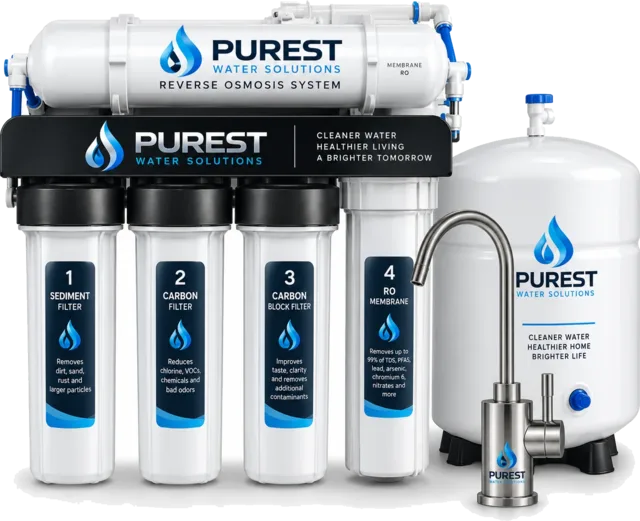
Under-sink reverse osmosis with a storage tank and its own faucet for drinking and cooking.
What it does
Under-sink reverse osmosis with a storage tank and its own faucet for drinking and cooking.
- Removes dirt, sand, rust and larger particles at the first stage
- Reduces chlorine, VOCs, chemicals and bad odors at the carbon stages
- Improves taste and clarity
- Uses an RO membrane for TDS, PFAS, lead, arsenic, chromium-6, nitrates and more
- Holds purified water in a storage tank, ready at the tap
How it works
Stages 1 to 3
A sediment filter, a carbon filter and a carbon block remove particles, chlorine, chemicals and odors, and improve taste and clarity.
Stage 4: RO membrane
The membrane removes dissolved contaminants such as TDS, PFAS, lead, arsenic, chromium-6 and nitrates.
Tank and faucet
The storage tank holds purified water so it is ready on demand. Its own faucet at the sink delivers drinking and cooking water straight from the RO system.
Benefits
Four stages
Sediment, carbon, carbon block and an RO membrane in one system.
Ready on demand
The storage tank keeps purified water available at the tap.
Its own faucet
Drinking and cooking water comes from a dedicated faucet at the sink.
Compact
Most residential RO systems sit under the kitchen sink and do not take up much space.
Which homes it fits
RO treats the drinking water at one faucet. It is often paired with a softener or a combo system for the rest of the home.
Questions about the Purest RO System
Reverse osmosis (RO) is a water purification process that uses a semi-permeable membrane to remove contaminants. Water is pushed through the membrane, leaving impurities behind.
Most residential RO systems sit under the kitchen sink, connected to a dedicated faucet.
Pre-filters and post-filters should be replaced every 6-12 months, and the RO membrane lasts 2-3 years. Maintenance plans can handle replacements on schedule.
Traditional RO systems do use some water in the filtration process. Our high-efficiency systems minimize waste, and the water used helps flush contaminants from the membrane.
They serve different purposes. A softener removes hardness minerals from all the water in your home. RO purifies drinking water at a single point. Many homes benefit from both, so a combo system is worth considering.
Book a free water test
A free in-home test shows hardness, chlorine, iron, total dissolved solids and pH before we recommend anything.